
The Newell Court Case: When Is an Attic an ADU?
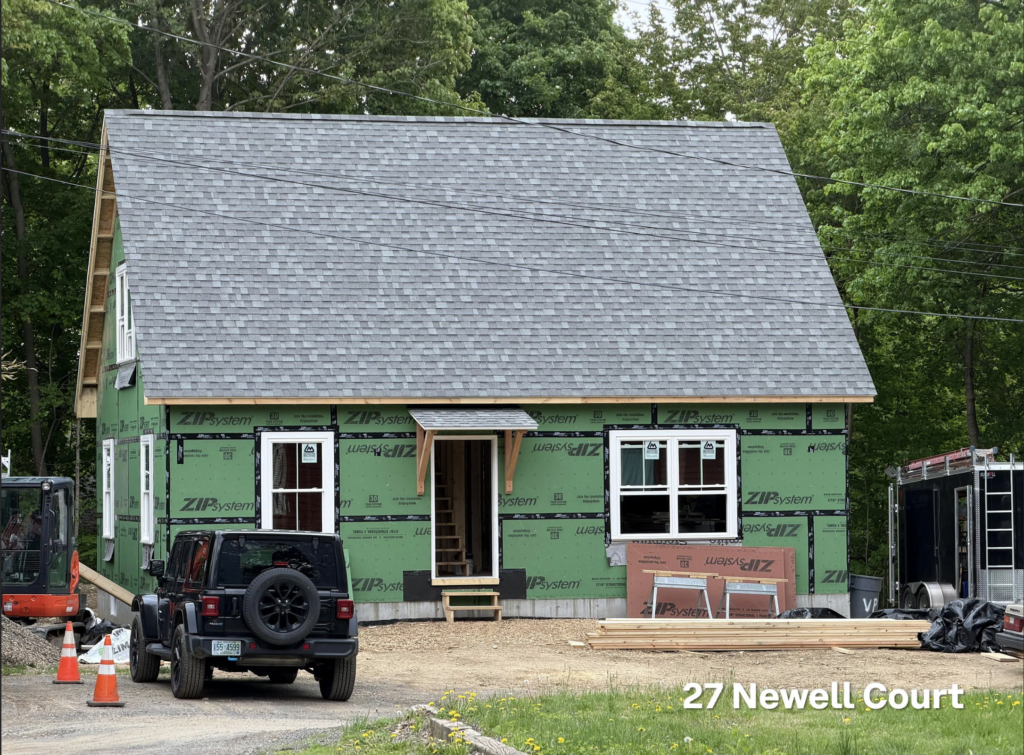
ADU currently under construction at 27 Newell Court. Photo: amherstma.gov
At the District 4 meeting on September 27, Councilors Pam Rooney and Jennifer Taub updated Amherst residents on recent Council actions and local issues, including one question that has become increasingly difficult to answer: how do you increase the town’s housing supply without creating a new set of conflicts over what can be built, who can build it, and what those additional units ultimately become?
That question is no longer theoretical. It has a street address: 27 Newell Court.
A developer was constructing an ADU of roughly 1,200 square feet over two floors. The dispute was not simply whether the developer had exceeded Amherst’s 900-square-foot threshold. The real fight was over what counted toward the gross floor area.
The lower level fell within the 900-square-foot framework. The upper level, however, contained finished residential space, including bedrooms and a bathroom. The developer argued that the upper portion qualified as attic space under the applicable rules and therefore should not be counted in the same way toward the ADU’s gross floor area.
Seemingly ordinary architectural feature became the central legal question: When is an attic actually an attic—and when is it simply another floor of an apartment?
If the upper level could legally be treated as attic space, the approximately 1,200-square-foot structure could potentially fit within the protected-ADU framework. If that space had to be counted as residential floor area, the calculation changed—and so did the regulatory status of the project.
The dispute moved from the Building Department to Amherst’s Zoning Board of Appeals after abutter Noah Kuhn challenged Building Commissioner Rob Morra’s interpretation. On August 13, 2026, the ZBA voted 5–0 to uphold Kuhn’s appeal, rejecting the interpretation that had allowed the project to proceed under the disputed reading of the ADU rules.
But then the case took another turn.
On August 25, 2026, the developer and related property owners filed a lawsuit in Massachusetts Land Court against the Town of Amherst and the Amherst Zoning Board of Appeals. The lawsuit challenges the town’s interpretation of the ADU regulations, including the treatment of the upper-level space. But it also raises a separate procedural question that could be just as important: whether Kuhn’s appeal was filed within the required deadline and whether the ZBA therefore had jurisdiction to hear it.
Kuhn’s position involved his efforts to obtain the relevant plans from the Building Commissioner and the question of when the appeal period should have begun. So the case is, also, about deadlines and jurisdiction.
The lawsuit involves nine additional Amherst properties associated with the plaintiffs and similar ADU designs. That means the eventual interpretation of Amherst’s rules could have consequences beyond the particular building at 27 Newell Court. The court is being asked, in effect, to resolve how the town’s newly revised ADU framework should operate when architectural design pushes directly against the boundaries of the zoning language.
The irony is almost perfect. Massachusetts expanded ADU opportunities as part of a broader effort to increase housing supply. Amherst revised its own rules to operate within that new framework. Then an actual housing project arrived at the precise point where state policy, local zoning, architectural design and neighborhood rights collide.
The 900-square-foot number was supposed to provide a boundary. Instead, it became the beginning of an argument over what counts as floor area. And the Land Court case may now help determine how Amherst interprets an entire category of new housing.
That is why 27 Newell Court is an early test of what Amherst’s new ADU policy actually means when the written rules meet the physical reality of a house.
Everyone can agree that the town needs more housing. The disagreement begins when someone has to decide exactly what kind of housing the rules are allowing—and where the line is drawn.
In this case, that line may be hiding upstairs.
See related Revisions to ADU Bylaw in the Works
Rizwana Khan is a writer, educator, and human rights advocate in Amherst.