
The Dorm That Was Private, Public, and Somehow Tax-Free
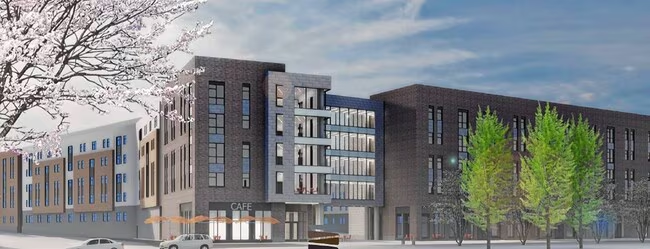
Fieldstone Apartments at UMass Amherst. The apartments were built through a public-private partnership and are tax exempt. Photo: umass.edu
At District 4 meeting, Sunday, September 27, Councilors Pam Rooney and Jennifer Taub brought up the very Amherst questions regarding housing, zoning, universities, development and, eventually, who pays for all of it. The meeting was billed as a chance for residents to hear updates and raise whatever was on their minds.
In July, Rooney and Taub were among four Amherst councilors who participated in a Massachusetts Special Commission on Payment in Lieu of Taxes listening session in western Massachusetts. The commission examines the state’s PILOT system that gathers testimony about the fiscal pressures created by tax-exempt and state-owned property. For Amherst, Fieldstone provides an unusually concrete example of why a private company operates expensive student housing, while the underlying university land remains outside the ordinary property-tax system.
At the September 14 Town Council meeting, Pam Rooney described the UMass agreement with Axium Infrastructure and Balfour Beatty Campus Solutions as exceptionally protective of the private corporation’s tax position. She also pointed to university assistance with Fieldstone utility work, the fact that the private partners did not purchase the land, and the treatment of the payments as service fees rather than conventional rent. Her larger argument was that an arrangement receiving those advantages should have produced housing that was considerably more affordable than what Amherst ultimately got.
Rooney and Taub have entered the PILOT conversation, where the question is: should universities and other institutions that hold enormous amounts of tax-exempt property be required to make a larger contribution to the communities that carry the cost of hosting them?
And Fieldstone a private apartment complex charges students like a private apartment complex, and is managed by private companies. But legally and financially, the land belongs to UMass, a public university whose property is generally tax-exempt.
Fieldstone was built through a public-private partnership involving UMass and private developers Axium Infrastructure and Balfour Beatty Campus Solutions. UMass itself describes Fieldstone as off-campus housing built on university land and says the university does not control the prices charged by the private operator.
Current Fieldstone listings show premium student apartments, with one recent graduate-student listing showing a total monthly price of about $2,016 for a studio, while earlier reporting placed Fieldstone’s market-rate rooms in the roughly $1,923-to-$2,608-per-bedroom range. The apartments come furnished, with private bedrooms and bathrooms, fitness facilities, study lounges, Wi-Fi and utilities bundled into the package. In other words, it is a highly amenitized, purpose-built student housing business.
The really interesting part is how the deal was structured. Fieldstone was organized as a Service Concession Arrangement, under which the private developers paid UMass an upfront concession fee and received the right to build and operate the housing on university land.
The Amherst Finance Committee began asking the obvious question in 2025: if the building is being operated by for-profit companies, why isn’t the building itself producing property-tax revenue for the town?
In September 2026, Town Council President Mandi Jo Hanneke and Finance Committee Chair Cathy Schoen pushed for future private developments on UMass land to generate revenue for Amherst. UMass representatives were not receptive to changing the basic structure, responding that this was how the partnerships would be structured.
And then the sentence that makes the whole arrangement sound like it was written by someone who had already anticipated the next five years of Amherst town meetings. Councilor Pam Rooney said the UMass contract with Axium and Balfour Beatty was extremely explicit about protecting the corporation from taxation and that the agreement contemplated litigation if UMass itself tried to assist the town in finding a way to tax the property. That is an important claim about the contract.
Her argument was essentially that the public-private structure reduced several major development costs, yet the finished housing remained among the most expensive student-housing options in town.
That creates an awkward economic equation for Amherst. If a private developer buys land, builds an apartment building and rents it to students, the property becomes part of the ordinary local tax base. A comparable private student residence on Olympia Drive, for example, was assessed at $18.5 million and does pay Amherst real-estate taxes. While, Fieldstone sits on university-owned land and was constructed through the UMass public-private structure. Amherst officials have therefore been left asking whether the public ownership of the land is effectively insulating a private housing business from a tax obligation that another private landlord would have to carry.
And this is where the phrase “public-private partnership” starts doing an enormous amount of work.
UMass gets additional housing without financing and operating the entire project in the traditional way. Students get new beds—but at prices that Amherst officials have now openly questioned. And the town gets to provide the surrounding municipal ecosystem while receiving no ordinary property-tax payment from the building, according to the town’s current understanding of the arrangement.
That last piece is where the town-and-gown relationship becomes much harder to romanticize.
Amherst provides roads, public safety, fire and emergency services, provides water and sewer infrastructure and inspections and the municipal systems required for a functioning community. The town and UMass have therefore spent years negotiating a Strategic Partnership Agreement intended to address some of these costs.
And, to be fair, UMass does contribute. The existing strategic partnership agreement includes $3.5 million over five years for fire and ambulance services, $400,000 for town services supporting safe and healthy neighborhoods, and $1 million over five years for Amherst’s public schools to support students living in university-owned tax-exempt housing. The town and university have created a negotiated relationship to address some of the costs of hosting a major public university.
But the disagreement over Fieldstone exposes a gap in that arrangement.
The town’s concern is that a private company can operate housing for profit on that tax-exempt land. Town officials are now explicitly asking that future agreements with private developers on UMass land include revenue for the town comparable to what private housing developers and operators contribute when their properties are outside the university’s tax-exempt land.
Cathy Schoen reported that UMass officials defended the high rents partly on precisely that basis: the private developer is taking risks and therefore expects a return.
Except the public side has already supplied one of the most expensive ingredients in real estate: the land.
And if the land is tax-exempt, the town is now asking whether the private partner should also receive the benefit of that public status.
Fieldstone arrangement may be perfectly legal and, also, economically rational from the university’s perspective. But the town can still ask whether the arrangement produces a fair distribution of costs and benefits.
The comparison with ordinary Amherst housing makes the issue even sharper. Amherst officials are now trying to understand and, potentially, renegotiate.
The town has already acknowledged that tax-exempt university housing can create costs when children living there attend Amherst public schools. That is why the 2023 Strategic Partnership Agreement included a dedicated $1 million contribution for education costs associated with students residing in university-owned tax-exempt housing.
But Fieldstone’s residents are overwhelmingly students themselves. There are no elementary-school children arriving with their parents because a graduate student rented a studio. The housing therefore creates a very different municipal profile from a new apartment development filled with families.
When Amherst talks about the cost of growth, a building filled with families may increase school enrollment. A building filled with university students puts different pressure on roads, fire protection, policing, water, sewer and other services while contributing relatively little or nothing to the conventional property-tax base.
So Amherst officials are asking a much more uncomfortable question:
If the university’s solution to its housing problem is to invite private capital onto tax-exempt university land, who pays for the community around that solution?
The university has said its new housing P3 process will consider transportation, dining, utilities, accessibility and infrastructure, and that UMass will retain authority over planning and governance. Thus the new process is not necessarily a repeat of Fieldstone and identifies affordability as a central consideration.
Meanwhile, the town’s Strategic Partnership Agreement, which expires in June will put the public-private projects back on the negotiating table.
And once you start looking at “public-private partnership” it begins to sound more like a very complicated accounting exercise: public land, private investment, university housing, commercial revenue, municipal services, tax exemptions and, somewhere, in the middle, a town trying to figure out how all those pieces fit into the same balance sheet.
Amherst has finally opened the spreadsheet.
Rizwana Khan is a writer, educator, and human rights advocate in Amherst.