
Members of the Four Towns Meeting Learn that Amending the Regional Agreement is a Multi-year Endeavor
By Maria Kopicki
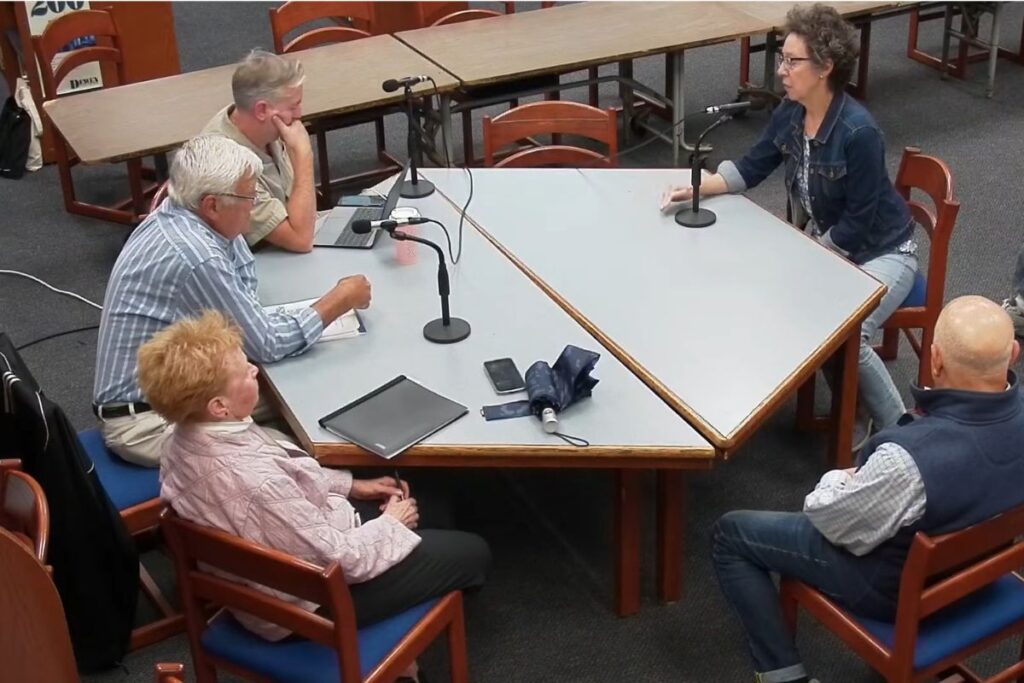
The meeting was held in person at the Amherst Regional High School Library and was recorded.
Members of the Regional School Committee (RSC), the Finance Committees and Select Boards of member towns, and the Amherst Town Council met on September 26, 2026 to discuss the Regional Agreement that defines the budgetary and governance structures of the Amherst Pelham Regional School District (ARPS). RSC Chair William Scherr explained that the purpose of this Four Towns Meeting was to understand the current agreement and what would be involved in amending it.
DESE identifies deficiencies in the current regional agreement
Michelle Griffin from the Department of Elementary and Secondary Education (DESE) was present and began by reviewing some general information about regional agreements (including the U.S. Constitutional requirement of 1 person/1 vote for governance). She said that amendments can include such items as changing the composition of member towns, changing grade configuration, closing a school, and leasing, selling, or granting access to regional assets. She also noted that the budgeting method (either statutory or alternate) that determines how the cost of running the district is divided up across the four towns of the region must be reviewed and voted upon annually by the RSC. Unanimous agreement is required to choose an alternate method and a two-thirds majority to approve the statutory method.
Griffin then offered feedback on the current ARPS regional agreement. The most recent review and approval of the complete agreement was in 1997, with a narrow amendment made in 2008. DESE’s 2024 analysis of the agreement identified many deficiencies, including the use of outdated language and terminology, lack of clarity, and non-compliance with current law and regulations. The process to rectify (amend) these issues is laid out in the agreement itself and will require thorough review by local officials, keeping the public informed, and review by ARPS legal counsel. The resulting draft is then submitted to DESE’s Office of Regional Governance (ORG) for review. Feedback is provided and a revised version is sent for legal review by DESE. Once vetted, the RSC votes on the full agreement which, if approved, is submitted by December 31 to the MA Commissioner of Education, which must grant final approval.
Sixth grade configuration and regional governance raise questions
Questions from participants focused on how sixth graders might be incorporated into the region and on the governance structure of the RSC. Until this fall Amherst sixth graders were educated at one of the three K-6 elementary schools, but with the opening of the new K-5 Amethyst Brook Elementary School, all Amherst sixth graders were moved to the Chestnut Street Academy in the middle school building while remaining part of the Amherst elementary district. When asked whether some member towns could allow their sixth graders to join the regional school district, Griffin responded that this would likely require special legislation at the state level and approval by all member towns. Superintendent of Schools Dr. Xiomara Herman asked whether, if the regional secondary school district became grades 6 through 12, member towns could keep a K-6 elementary school model; Griffin’s answer was “No.”
Regarding the governance structure, the RSC is currently composed of all five Amherst School Committee members (who govern the elementary district), plus two Pelham School Committee representatives and one school committee representative each from Leverett and Shutesbury. Several questions were asked about whether the current RSC composition meets the requirements of representation based on population. (Amherst accounts for a much larger percentage of the students in the regional school district compared to the three smaller towns.) Griffin referred the participants to Massachusetts General Law Chapter 71, Section 14E, that requires that one of the following five methods be adopted:
1) electing committee members by voters in member communities with each community’s representation apportioned according to population;
2) electing members in district-wide elections to be held at the biennial state elections;
3) electing members with residency requirements in district-wide elections to be held at the biennial state elections;
4) weighing the votes of committee members according to the population they represent;
5) appointing committee members by locally elected officials such as school board members.
Griffin indicated that she would be willing to seek further legal clarification and provide written responses to specific questions if participants provided written questions. She also promised to provide a version of the existing agreement that has been annotated by DESE to show their areas of concern.
Amending the agreement could take several years
A presentation by Jay Barry from the Massachusetts Association of Regional Schools (MARS) provided more details about the regional agreement amendment process. A two-thirds vote of the RSC begins it, frequently including the formation of a subcommittee consisting of executive, financial, and school leadership representation from each town. Open Meeting Law applies to this body to allow stakeholders to be aware of the proceedings. He emphasized that the process involves a great deal of work and time (at least one year, sometimes several) and cautioned that while most produce an amendment that is ultimately adopted, they sometimes do not come to fruition. He pointed out that the RSC may decide to seek assistance from a consultant (such as MARS) to complete the work and noted that state grant money would be available to cover some of the resulting costs. Any amendment that is proposed must be vetted and agreed upon by the subcommittee, be approved by a two-thirds majority of the full RSC, undergo legal review by each of the towns and the counsel for the RSC, be reviewed by the ORG, and return to the RSC. MARS recommends holding an informational meeting for the public at this point as each town’s legislative body must vote on whether to approve the new agreement. If all member towns approve, the amended agreement is sent to the Commissioner of Education for approval.
Scherr next sought input from attendees on the composition of the subcommittee for the RSC to consider. Some suggestions included adding district staff, an at-large Amherst resident, Amherst Finance Director Sean Mangano, and town administrators. Scherr asked participants to send any other input as well as questions for DESE and MARS either to him (as chair) or to the RSC’s email address by October 9, so that the RSC would have their input when they discuss these issues at their next meeting on October 20. He ended the meeting saying that if anyone was expecting these decisions to be made by the end of this year, they should instead prepare for a 2- or 3-year process.