
Planning Board Rejects Moratorium for Hampshire College Rezoning, Begins Evaluation of Amherst College Daycare and Apartment Complex on Dickinson Street
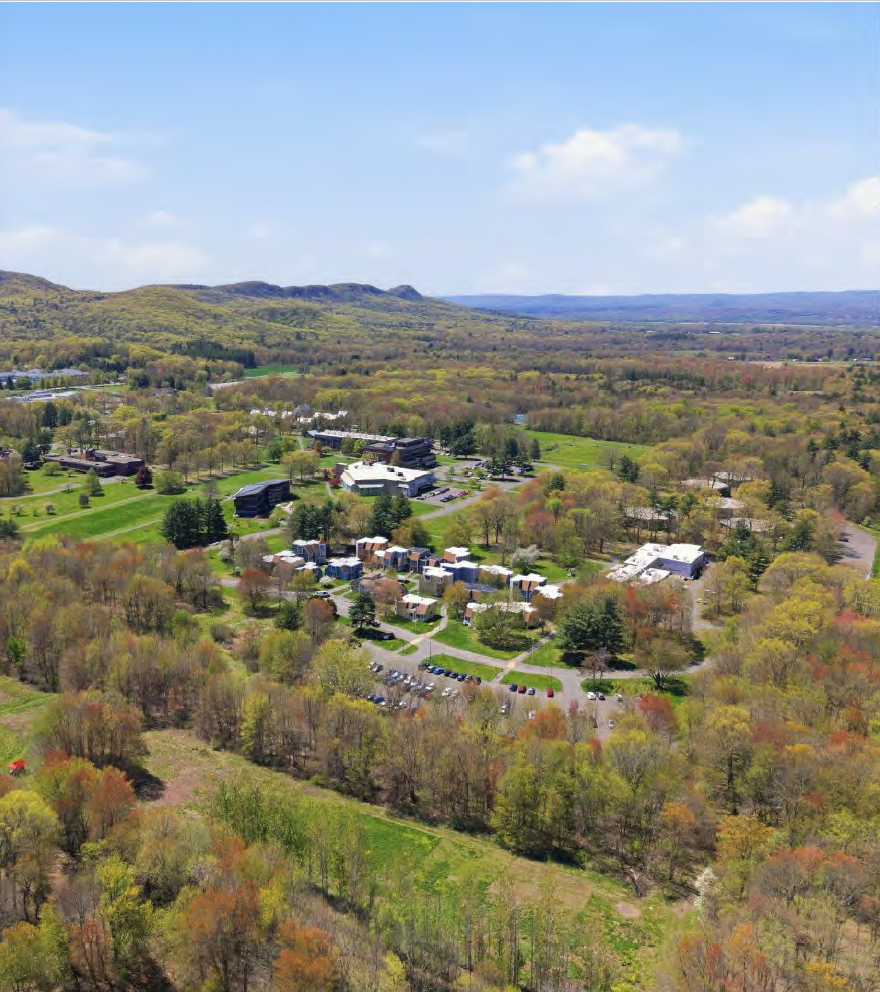
Aerial view of Hampshire College core campus. Photo: hampshire.edu
Report on the Meeting of the Amherst Planning Board, Nov. 18, 2026
This meeting was held over Zoom and was recorded.
Present
Planning Board: Doug Marshall (Chair), Bruce Coldham, Roy Johnson, Jesse Mager, Jerah Smith, and Angus McLeod.
Staff: Walker Powell (Planner) and Pam Field-Sadler (Assistant)
Planning Board Rejects Moratorium on Rezoning of Hampshire College
The Town Council referred a citizen petition for a one-year moratorium on rezoning Hampshire College to the Planning Board for a recommendation. After hearing from supporters of the petition, the board voted unanimously against recommending the proposal.
Hampshire College alumnus and petitioner Zain Salim contended that his outreach in Amherst showed that “lots of people shared our concern that the process was taking place too quickly and with poor public input mechanisms.”
Petitioner Will Chaney asked for more time to prevent the Hampshire Campus from being sold to a for-profit venture. He advocated for something that would benefit the community, specifically a cooperative college that would center Landback efforts. The group Hampshire Commoning is crafting a plan using democratic cooperative economics, which, he argued, is a feasible way to run a college. He asked that the town slow down its rush to rezone the campus to consider uses of the land, other than housing.
Petitioner Celyne Camen spoke about preserving the college’s character and leaving time for thoughtful development.
Samuel Bedree maintained that building housing would be cost-inefficient for the town because any additional school children would cost more than the tax revenue from new construction.
Planning Board member Angus McLeod was sympathetic to the petitioners, but said, “When the initial proposal for the Archipelago project fell through, I was really concerned about how this would affect Hampshire. Hampshire then announced it would close a few months later, and that has put us all in a bind, because none of us own that land. Hampshire College owns the land, and they are deeply in debt. Even if we don’t rezone, the land will be sold to satisfy the debt. If it’s a fire sale because it’s all still zoned educational, which limits the uses and potential of the property, then I don’t think that’s actually a good outcome for the town. I think this moratorium is a bad idea, because I don’t think that the town should be tying its hands when the college is going to dispose of this land pretty quickly.”
He continued, “I really appreciated Will Chaney’s interview (on WMUA). I found it really inspiring and exciting. I think Hampshire College is a wonderful asset, and I’m deeply sad about what’s happening to it. I wish we had the power to make something happen there, but I don’t think that we do.”
He concluded, “I’ve wanted to have more information about how Hampshire College is thinking about selling its land. Thinking about this Hampshire Commoning group, what they’re proposing around different forms of higher education, continuing education, student-run education is really exciting. I know that the continuity would be wonderful. Hampshire has an amazing heritage. I hope there’s a way we can honor that heritage in the future as a town.”
Jerah Smith added, “I, too, admire the goals of the petitioners, but I just don’t think that we have the kind of control that they may think that we do. We also need to acknowledge the trade-offs, because when I hear statements about people profiting off this, I understand the frustration. But the tax revenue can fund the schools, sidewalks, and library.”
Bruce Coldham did not see any value in a moratorium, because the town has consulted reputable firms to guide the rezoning procedures and has already held three public input sessions, with more scheduled.
Roy Johnson noted that many small colleges in the country are closing, and said that if Hampshire College could be resurrected, it might end up in the same situation down the road.
Planning Board Chair Doug Marshall pointed out that Hampshire College is a nonprofit, so he thought that the goal of the trustees was to pay off the debt and dissolve the entity, not to make a profit. Any money left over would need to be donated to an educational or charitable cause. He cautioned about what happened in Northfield when the Northfield campus was sold to several educational institutions over the years, generating no tax revenue and little activity.
The vote was 6-0 against recommending that Town Council adopt the moratorium. The Planning Board also declined to hold a public hearing.
Discussion Begins on Amherst College Daycare/Faculty Housing Project on Dickinson Street
The Planning Board opened a hearing for a proposed mixed-use building at 24 Dickinson Street. Barry Roberts is the developer, but the building will be leased to Amherst College, with a daycare center on the first floor and 19 apartments on the second and third floor.
Roberts has asked that the inclusionary zoning requirement for two affordable units be waived, and will contribute nearly $2 million to the Amherst Municipal Affordable Housing Trust (AMAHT) as compensation. At the November 12 meeting, AMAHT recommended that the Planning Board accept the payment in lieu of affordable units, but they worried Amherst College might eventually purchase it and asked for assurance that the property would remain on the tax rolls.
Attorney Tom Reidy of Bacon, Wilson, LLC and architect Jonathan Salvon of Kuhn, Riddle Architects presented the plans. McLeod recused himself from the discussion because he is an employee of Amherst College and his children attend the college daycare center at Woodside that will be replaced by the proposed project.
Construction of the new building has required that the house at 24 Dickinson Street be moved. In order to save a large sugar maple at the north side of the property, Roberts has asked the Historical Commission to allow the house at 34 Dickinson to be relocated as well, so the building can be located farther south on the property. The Historical Commission hearing is scheduled for December 15.
The proposed building will be wood-framed and Passive House certified. A large driveway will provide front parking for daycare drop-off, with a larger parking area to the south. Tenant parking will be near the Amherst College maintenance facility at 40 Dickinson Street. Altogether, 47 parking spaces are planned, with EV chargers and two handicapped spaces.
The units include one studio, one three-bedroom, nine one-bedroom, and eight two-bedroom units, with an average area of 840 square feet. The daycare center will accommodate up to 70 children and 18 employees. Two outdoor play areas will be located at the rear of the site, over the subsurface stormwater filtration system. Completion is targeted for the summer of 2028.
Several criticisms were expressed by board members and the public. Many thought the drop-off plan at the daycare center would not work because parked cars would be unable to leave if others were queued in the drive. Others thought it did not fit in the neighborhood close to the Dickinson Local Historic District.
Hilda Greenbaum said the design looked more commercial than residential and suggested embellishing the windows “to make it look less like a ski hotel.” Marshall said his first impression was that the design looked like a hotel. He also thought that the tenant parking was too far from the entrance. In the design presented, tenants would have to walk all the way around the building to the designated entrance.
Abutter Mindy Sahner was pleased that a maple tree would be saved, but also supported retaining the Gothic Revival house at 34 Dickinson. She stated that with that house gone, the view east from Spring Street would be a large parking lot. She wanted to make sure the area was well screened.
Johnson asked about anticipated tax revenue from the project and whether that would be lost if Amherst College purchased the property. Reidy estimated that the building would be valued at about $15 million. He said that the implications for taxes if Roberts sold it to Amherst College would need to be negotiated by the Town Manager and the President of Amherst College.
The designers will consider the suggestions made and return to the Planning Board meeting on December 16.
Board Members Express Frustration at Being Asked to Stop Proposing Zoning Amendments
Marshall reported on a conversation he had with Planning and Economic Development Director Jeff Bagg a few weeks ago where Bagg asked the Planning Board to slow down generating zoning changes, because the Planning Department has its hands full working on the rezoning of Hampshire College, evaluating the Downtown Design Standards, and the development of the rezoning of East Amherst. He said they can’t spare town staff time to evaluate new proposals from the Planning Board.
Planner Walker Powell, serving as staff liaison to the board, said the Planning Department may move the plan forward to rezone the Professional Research Park zones to allow housing, but more complicated rezoning, such as the campus-adjacent zone, would involve too much work.
Smith remarked, “I feel that frustration of feeling like we’re being reactive and not necessarily proactively addressing some of our town’s biggest problems.” He recommended that the board continue its discussions.
McLeod suggested that board members meet with town councilors about their zoning priorities. He expressed frustration that the board spends so much time on proposal details and zoning bylaws rather than larger issues. Mager recommended adapting the board’s 2026 list of priorities to the present situation. He said he joined the board to work on larger issues around housing and was unhappy about pausing that work.
Marshall noted that the board cannot always set their own agenda. They finalized the ADU bylaw, and it then returned to the Planning Board for clarification on definitions. He said that he was sorry to end the meeting on a down note.
It sounds reasonable to me that Jeff Bagg is being realistic about the capacity of the planning department – there is undoubtedly a lot going on, that could each be a SNAFU we’d regret not avoiding. And though the Town Council has previously rejected the idea of a moratorium to discuss further development in the town center, this requested pause may be just the thing the Planning Board needs to have some discussions about how to not destroy more neighborhoods by allow whatever the traffic will bear. How about figuring out how full is Amherst, in the meanwhile? Instead of struggling to fit tall dorms into whatever bedrock is on a wet property, how about figuring out if we have the resources (ie: getting water to a fire, land that will not flood, places for seniors to downsize), or maybe should we realize it’s time for better negotiations with UMass? Maybe the best place for our town to build more housing is ON CAMPUS!!!