Construction of Amethyst Brook Elementary School Is Complete; Move-In Is Underway
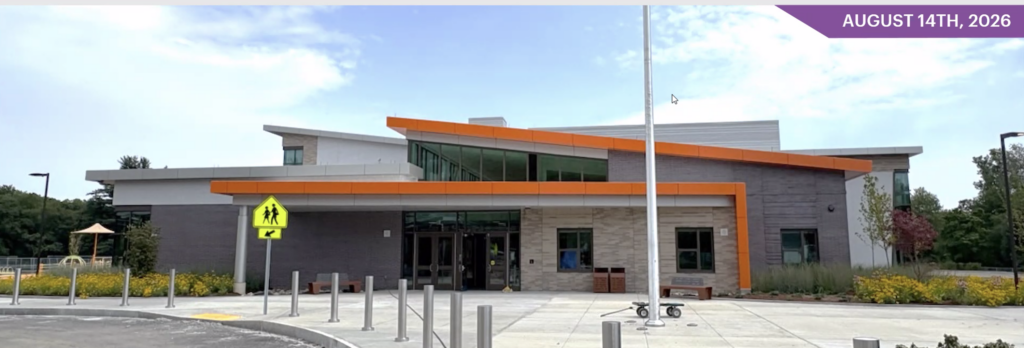
Entrance to the Amethyst Brook Elementary School. Photo: amherstma.gov
This meeting was held over Zoom and was recorded.
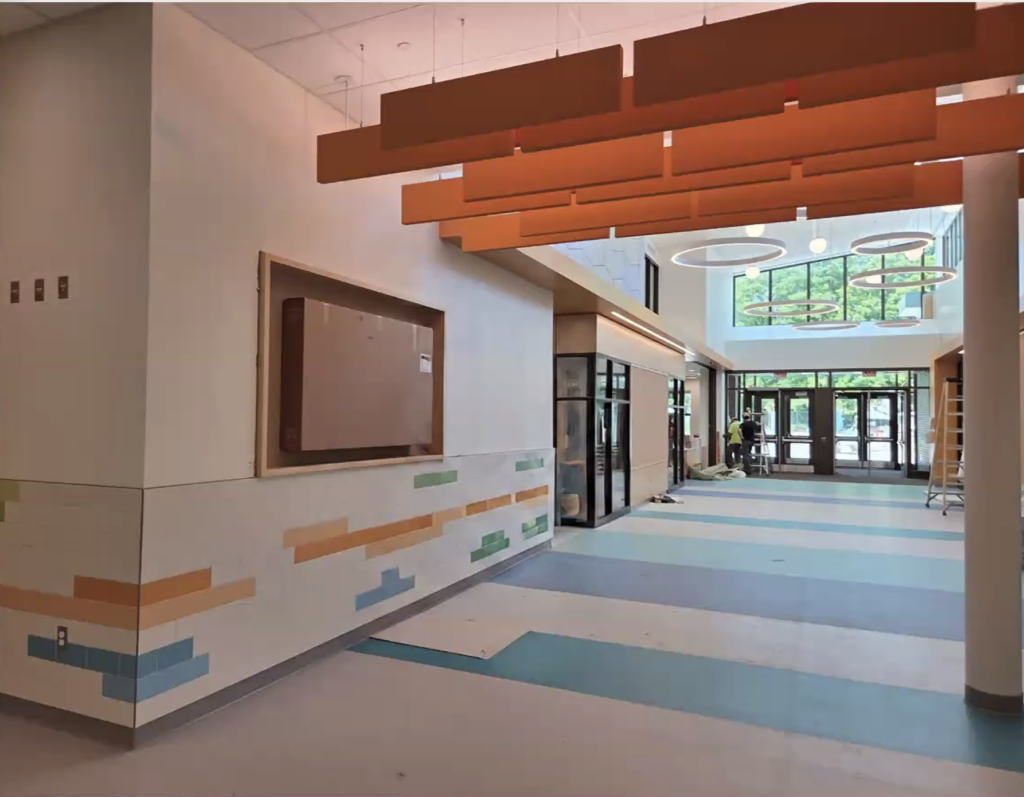
The Elementary School Building Committee received reports at its Aug. 14 meeting that construction of the Amethyst Brook Elementary School is substantially complete and move-in is underway. The building has received an unrestricted temporary certificate of occupancy and will be ready for the first day of school on Wednesday, Aug. 26.
Construction Report
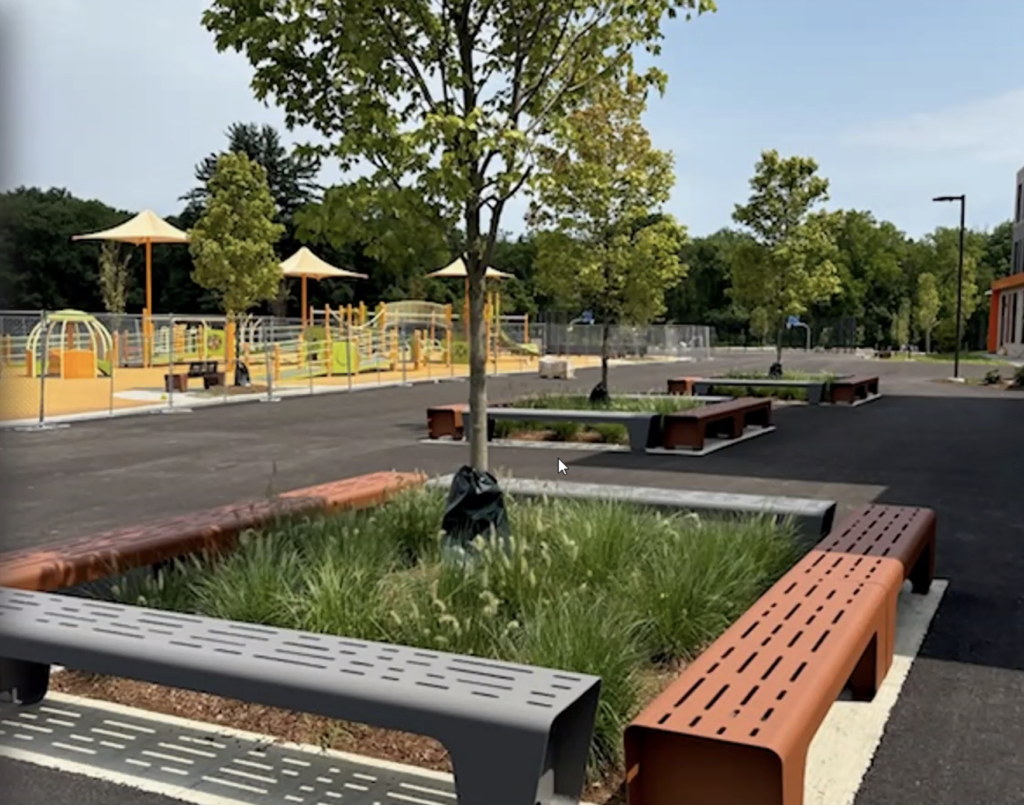
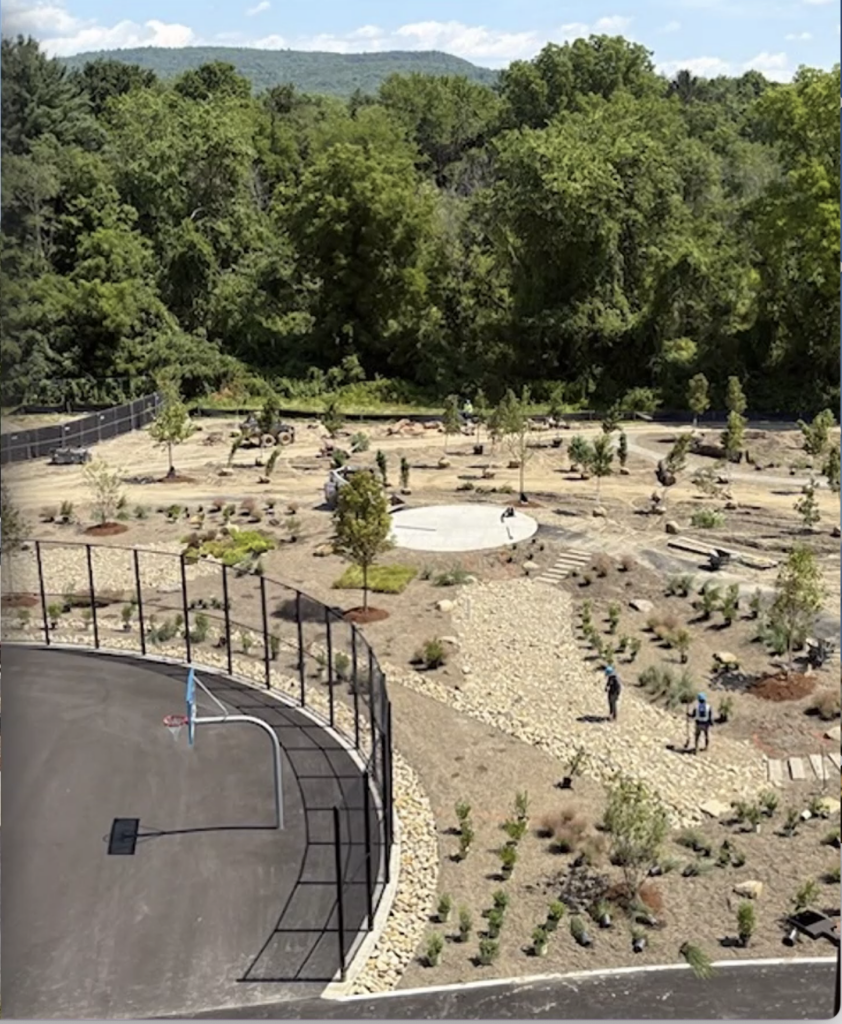
Owner’s Project Manager (OPM) Kseniya Slavsky of Anser Advisory reported that all flooring is installed, the heating system is in, gardens have been planted, and 90% of the furniture, fixtures and equipment (FF&E) has been installed. Work is now focused on setting up classrooms, a process that will begin Aug. 17.
Installation of solar panels on the roof and parking lot canopies is nearly complete. Parking lot and northern driveway paving are complete, and a third driveway will open just south of the north entrance.
Abatement for demolition of the old Fort River building is now underway. Construction of new fields will follow the building’s demolition.
Student tours of the new building are planned for several evenings.
Committee member Alison Estes, the incoming principal at Amethyst Brook, said it’s exciting to be in the new building and that staff is thrilled to see what’s possible. It’s a beautiful building, she said, noting how supportive the construction team has been to the staff. Others on the committee shared her enthusiasm. Town Manager Paul Bockelman credited the entire team for a job well done, noting “the joy and optimism that this building has brought to the community.” He also quoted a letter from Building Commissioner Rob Morra praising the construction and design teams.
Energy Consultant Will Help Optimize the Building
Slavsky reported on the steps remaining to make the town’s first net-zero building fully operational. Commissioning — the functional testing of equipment — is nearly complete. The facilities team is being trained to manage the new equipment. The team will track energy use optimization over the next year.
Slavsky recommended bringing on a consultant that specializes in helping schools optimize their energy use, noting the challenges of energy management in net-zero buildings. She recommended Interval Data Systems, a building automation consultant based in Waltham that has been used by recent school projects in Lexington, Belmont, Arlington and Stoneham to optimize building energy management. The engagement would run at least one year to calibrate all the new systems. Slavsky said Belmont reported it would not have been able to reach its EUI, or energy use intensity, targets without Interval Data Systems’ help. The consulting contract would be with the town for $113,000 for the first year. Bob Pierent, the town’s special capital projects coordinator, endorsed the recommendation, adding that he does not anticipate this being a permanent relationship but rather a short-term engagement to optimize the energy systems.
Committee member Bruce Coldham pointed out that over the first year of consulting, the school will establish a relationship with the company that will enable Amherst to draw on its support as needed in the future.
After the initial year of operation, another commissioning effort, similar to the one happening now, will certify that the building is meeting its energy targets.
Pierent reported on the process of connecting the school’s photovoltaic (PV) complex to the grid. He said the remaining steps are complicated. The last PV panels are slated for installation in the next few days. He said installation of fiber optics for the school’s networking systems must be coordinated with Eversource. The real-time automation controller that will allow the building’s PV system to communicate with Eversource will be installed in the next couple of weeks. Two grounding transformers needed to connect the PV system to the grid are on order; they are expected to arrive a couple of weeks after school opens, and connecting the school’s PV system to the grid will have to wait until they are installed. Pierent noted that “cooperation with Eversource has been great.”
Outstanding Question
Committee member Deb Leonard asked about the status of the seclusion rooms — also referred to as blue rooms, oasis rooms, and reflection rooms — spaces designed to help students self-regulate. She noted that the design of these rooms has been a concern of the Amherst School Committee. Estes said she has been in conversation with the Special Education Parents Advisory Committee (SEPAC) about the rooms’ design. She said interior doors have been removed. Crash pads have been retained on the walls of both seclusion rooms to ensure they are available when needed. She said the rooms will be decorated colorfully with bean bags, weighted blankets, a tent, and wall décor to feel like a safe and inviting space for children. Staff will make the final decision on what to call the rooms.
Invoices Paid
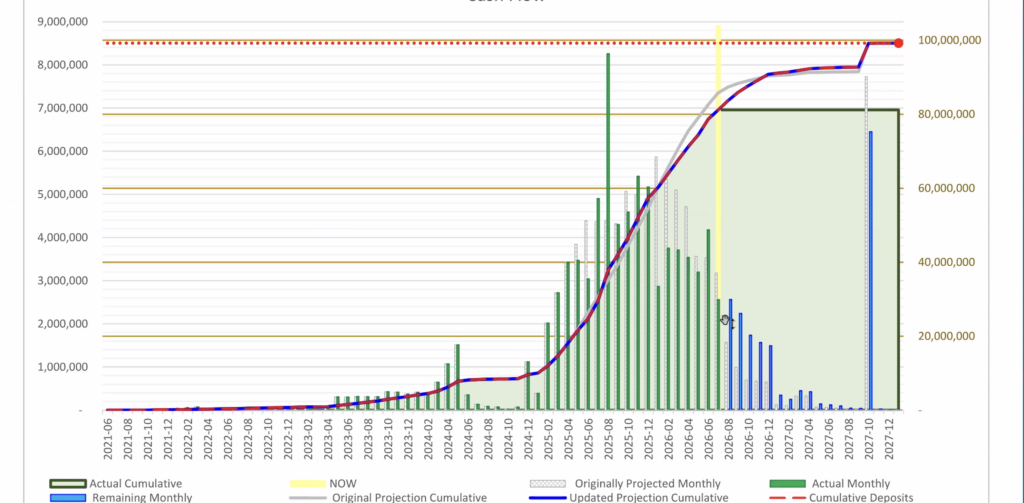
The project paid $2,561,123.32 this month, with about $10 million remaining. This month’s invoices were not yet in the packet, which can be found here.