
Opinion: Thrive or Perish: Transforming Admissions Will Dictate Whether Hampshire College Prospers
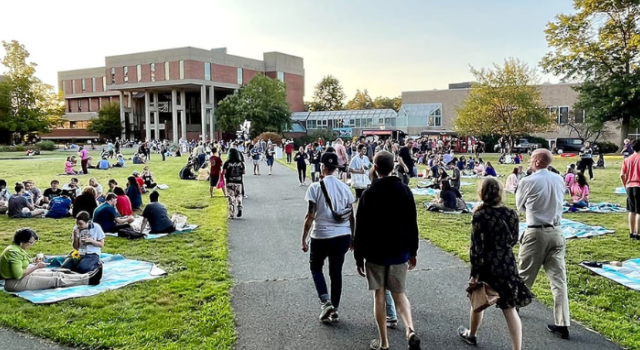
Photo: hampshire.edu

In October, 2025, Jennifer Chrisler was appointed the 9th president of Hampshire College after serving as interim president. Her opening speech articulated some of her vision for Hampshire, including continuing its leadership role in higher education innovation. The challenges are steep. After several years of enrollment increases, Hampshire reduced admissions staffing, and enrollment is back down to approximately the 2019 level, the year it declined an incoming class.
Student recruitment is challenging, but Hampshire has the power to turn things around. The keys are rebuilding staffing, developing a cutting-edge strategy, and leveraging domain expertise with community talent. A deeper look indicates that Hampshire has failed to vigorously prioritize enrollment across the terms of several presidents. If we understand why this happened, the Hampshire community can rally into sustainability.
Hampshire College Total Enrollment (Fall) 2010-2025
(sources: hampshire.edu and U.S. News & World Report)

Thrivers
Back in 2010, under President Ralph Hexter, Hampshire reached peak enrollment but student services were stretched, student housing was overfilled, and attrition had increased. In 2013, under President Jonathan Lash, Hampshire began a study of “thrivers”; they identified students who professors thought were doing well, deciphered key attributes, and tested their hypothesis via other applications on file. The college’s researchers determined that test scores did not correlate with success at Hampshire, so the college transitioned from test-optional to test-blind (meaning they won’t consider SAT or ACT scores).
Hampshire reduced merit scholarships, added additional essay questions to the application, and focused on the identified thriver attributes in the selection process. Dr. Erin Margaret McCubbin wrote her dissertation about this change at Hampshire. She admits that retention didn’t improve, though she notes that external factors also affected retention.
In 2019, The Washington Post quoted David Matheson, a trustee leading the board’s finance committee, explaining that, “We knew when we adopted that strategy that we would be pruning the applicant pool to some degree. What we may not have realized is that more of those pruned people may have been higher-income than we anticipated.” The article stated that, “In 2013, the college’s average first-year student was paying 56 percent of the listed tuition price. By 2018, that was down to 40 percent.” The other problem was that enrollment levels didn’t stabilize despite the millions of dollars that were invested in the new strategy.
Miriam Nelson took over the presidency in 2018 and inherited many of the Lash administration’s assumptions. Lash told Nelson that enrollment for the Fall of that year was lower than expected, and rather than engaging in cost-cutting, fundraising, and other reforms, she pursued secret talks to find a strategic partner. Public records obtained by Daily Hampshire Gazette showed that if UMass had acquired Hampshire, they likely would have put the college into a wind-down. Hampshire’s president laid off the fundraising and admissions staff and decided not to accept a Fall 2019 class. The community rose up and successfully pressured the administration into leadership changes, bolstered by reinvigorated fundraising and a rethink of Hampshire’s academic future.
Ed Wingenbach came in as the new president in August 2019, and the college proceeded with fundraising and curricular innovation. Wingenbach appointed Fumio Sugihara as Dean of Admissions and Financial Aid. The pandemic was another major blow to admissions, but the new admissions team raised enrollment by 68% (from 500 to 833) in two years. In contrast to Thrivers, which was more qualitative, Sugihara used a quantitative, data-informed approach, as he explains in the Orthot case study on predictive modeling.
Cutting Admissions Staff Again
In 2024, Hampshire made cuts to close its budget deficit. Those cuts included ⅓ of admissions counselors, one management position, and some support staff. There was further turnover, reducing the staff’s overall experience level. Admissions was folded into a new department called Institutional Support, which encompassed a wide range of functions (events, marketing, alumni relations, fundraising, etc.), meaning the dean of admissions would now report to the VP of Institutional Support rather than to the president.
Eric Pederson is a veteran of higher education enrollment. According to an informal poll on his LinkedIn, it’s harder to recruit a new dean if they don’t report directly to the president. I asked Hampshire administrators why they had made the cuts, given the possibility that they could affect enrollment. They indicated that they had acted in response to lower enrollment revenue and that the changes they made, combined with external factors, further affected enrollment. Click here to read their statement in full.
Effects on Enrollment
Admissions staff reductions can lead to lower enrollment, in part because less personalized attention may lower yield (the percentage of accepted applicants who go on to enroll). According to this AACRAO article, “Admission staff turnover has harmed offices across the country, and it’s hard to succeed when hiring multiple positions mid-cycle and spreading the remaining staff thinner. In our survey of enrollment leaders, we asked about staffing changes and found a strong correlation between staffing levels and the pacing of enrollment deposits.”
Out of 54 higher-education institutions responding to the survey by Niche.com of 891 leaders at undergraduate institutions, “Only 12% of those with fewer staff reported an increase in deposits compared to 45% of those with similar staffing and 57% of those who increased admission staffing.” Put another way, 88% of the institutions that reduced staff didn’t increase enrollment. Hampshire’s strategic recovery plan forecasts enrollment growth, and deviations from that require further budget cuts.
I wrote to Angel B. Pérez, CEO of the National Association for College Admission Counseling, who told me that, “In my experience, as a former Dean of Admissions, the more counselors I had on the road—working with families, reading applications, and cultivating relationships with high school counselors and students—the more my applications and enrollment pipeline grew.”
Pérez is also the author of The Hottest Seat on Campus, which provides wisdom for handling the pressures on admissions deans. “The list of people you may anger with enrollment outcomes is endless, and they all have valid reasons for challenging your decisions as an admissions leader.” It’s essential to find a good match and use various strategies to manage stress. The book is geared toward current and future admissions deans, but would be a useful read for anyone who wants to learn about hiring and retaining the best ones. A number of exceptional deans were featured in the book, including Sugihara, who was quoted as saying that at Hampshire, “I’m the happiest I’ve ever been.” (February 13, 2024). This was prior to the budget cuts and restructuring.
Effects on Staff
Reductions in the number of admissions counselors put greater pressure on those who remain to boost enrollment, but the ratio means there are fewer counselors per prospective student. This exacerbates the current problem admissions counselors face, including morale issues and competing demands on their time.
Typically, admissions counselors take on the job because they love students, a college, or both, but the job has changed over the last twenty years with an increased focus on data. I interviewed Teege Mettille, author of the Admissions Counselor’s Malaise. As customer relationship management software and other technology improved and the number of college applications increased, admissions departments moved from a “high touch” to a “high tech” approach. Mettille conducted an extensive time study revealing that counselors now spend up to ⅓ of their time behind screens. This mismatch is one of the reasons admissions departments sometimes have lower morale and higher turnover than other departments, and and that has continued to worsen since the pandemic.
How Can Hampshire College Turn Enrollment Around?
Restaffing is essential, but admissions is highly specialized; recruiting takes time; good deans are in high demand; and counselors can take up to a year to perform well on the job. In the meantime, how could Hampshire improve employee morale, retention, and effectiveness?
The Higher Ed Admissions Workforce report states, “Colleges and universities would benefit from considering how they could reconceptualize crucial admissions positions, particularly admissions coordinators and counselors, to encourage higher retention. An admissions workforce that uses their experience to gain deep insight into how to highlight their institution’s strengths may be just the edge colleges and universities need in the era of the enrollment cliff.”
Mettille advocates using technology and strategy to reallocate much of their time away from tech/mass approaches toward personalized approaches for the particular students at the right times, when there is the greatest likelihood of having an effect (the “maybes”). That’s even harder with fewer admissions staff, which means more prospectives per counselor and fewer support staff to help with analytics. He told me: “The drive needs to be towards more, not less direct individual engagement with students. Someone at the institution has to find a reasonably good way to identify which students on any given day to be interacting with…to look for those little signals.”
This opens the possibility that staffing could include analytics specialists (the college has done some of that in the past), so that counselors can spend less time working with data and more time with prospective students. Data specialists have different skill sets and preferences from counselors; having separate job specializations would allow people to focus on the work they prefer and are the best at.
Evergreen State College
Krukowski Associates created a Hampshire student recruitment marketing study in 1982, which I’ll refer to as the Krukowski Plan. One suggestion was that, “The faculty must be directly involved in recruitment.” That actually happened in recent years, and in a robust way, at Evergreen State College, an institution similar to Hampshire that has no grades or traditional majors. I reached out to Evergreen Provost Noah Coburn, who told me that, “Our growth from F22 to F25 has been over 30%… [partially due to] recruitment efforts, which, with the assistance of our faculty union, has relied on faculty as key communicators with prospective students.”
According to Evergreen’s website, first-year retention has increased from 68% to 85% over the last five years. Coburn says that, “It has been both our cross-institutional holistic support for student success, ranging from professional advisors, mental health professionals, coaches, and faculty, but also the fact that an Evergreen education particularly speaks to our moment, giving students the interdisciplinary, collaborative skills they need to engage in a world that is being disrupted by AI, growing inequity and a political environment that has grown more hostile to expanding access to higher education.” Working on the retention issue from a more holistic approach seems to work better than Thrivers and was envisioned more than 40 years ago in the Krukowski Plan.
Volunteering
A former Hampshire employee in a position to know about admissions work told me that “those who are not embedded in admissions as a full-time gig and those who are not immersed in the day-to-day operations of a specific admissions team don’t usually add to the value of the work…There are workflows that are crucial to the timing and process of literally hundreds of procedures in admissions. Trying to push new systems from the outside actually seems counterproductive to me.”
Similar views are not only held by some staff but also by college leadership I spoke with after the grassroots movement helped save the college in 2019. Rather than seeing them as a source of energy and genius to fully incorporate, there was a tremendous backlash. But volunteers also need to understand staff’s time constraints and their need for respect, autonomy, and recognition.
Teege Mettille worked in admissions departments for years. He offered the insight that, “If there’s a committee of alums or a committee of parents, a committee of whoever, the question is not, what do you think Hampshire can do? The question is, with minimal support from the campus, what do you think you can do that would help? And if they keep the focus not on what other people should do, but what they could do, I think that would land better with the staff. [Alumni could say] ‘If you just send us a bunch of your books and table banners, we will cover 50 college fairs.’”
Another way to make this work is to assign a dedicated staff member to handle volunteers. In 2019, it was envisioned that two admissions staff members would handle volunteers. Volunteers can discuss best practices and share success stories via a private social media channel and enhance the alumni toolkit.
Student Volunteers
A simple strategy would be to give students who request it some table materials, talking points, and a video training so they can talk to admissions counselors at their former high school or table there when they are back home, on break from college. Eventually, Hampshire might want to see whether there are aspects of Deep Springs College’s admissions process to emulate, as described here: current students conduct interviews, read applications, and have prospective students spend a few days on campus. Hampshire used to have overnight stays for prospective multicultural students and had a hometown high-school program, so those programs could be revitalized.
Hampshire Admissions Associate Program
According to the Hampshire Admissions Associate Program (HAAP) manual revised in 2016, in a typical year, HAAP volunteers represented Hampshire at 10 to15 college fairs in both the fall and spring. The college’s guide stated that there were 350 alum volunteers back in 2012. The program is mostly gone today. It would be worth having a group of alumni volunteers put together a revised plan. The volunteers could appoint a single point person to interface with an admissions department administrator to avoid being a distraction for counselors.
Parents
Krukowski Plan said, “Regional ‘parents’ nights’ conducted in key recruitment markets around the country by parents of current Hampshire students. All prospects and their parents in the appropriate city, town, or region would be invited. Sponsoring parents would preside over the evening, which would feature an informal presentation by a panel of students on the work they are doing at Hampshire and how that work has focused their thinking about life after college.” Parents of current Hampshire students invited me to meet via Zoom after my last article on admissions. The brainstorming session came up with lots of great ideas, including the concept of parents creating a registry of parents, students, or alumni who are willing to speak with prospective families.
Conclusion
Returning the dean of admissions position to a direct report to the president and committing to full staffing in admissions are essential signals to prospective new hires. It’s also important to hire an experienced dean who has worked at a similar college before. There are pressures throughout all departments at Hampshire and other colleges, but the extreme pressures on retention within Admissions and its pivotal role in returning Hampshire to financial viability mean that it should also be exempt from future reductions in force or pay cuts while Hampshire completes its stability plan.
As Pérez wrote in The Hottest Seat, “Without the admission office, there are no students. Without students, there is no revenue. Without revenue, there is no college.” Reducing admissions staffing levels should never have been considered, because it had a significant likelihood of causing an enrollment downturn and necessitating budget cuts for years to come, since each student lost might have attended for several years.
Phil Stone, who was president of Sweet Briar College after its brief closure, demonstrated an attitude toward enrollment that Hampshire should emulate when he “instructed admissions officers to bring every prospective student to him, whether he is in his office, in a meeting or somewhere else on campus. He wants to say hello and encourage prospects to enroll.” I wrote in ”To Succeed, Hampshire Must Get a Lot Weirder,” that Hampshire needs a community-wide effort, and to improve marketing, it needs to show, not tell: be bold and straightforward. Hampshire has a short time to restore its enrollment trajectory and, simultaneously, to add other revenue streams.
Jonathon Podolsky is a Hampshire alum, journalist member of the Education Writers Association, and a Boardsource Certified Nonprofit Board Consultant. More at www.Podolsky.cc