
Opinion: There Are Plenty of Reasons for Accreditors to Continue to Support Hampshire College
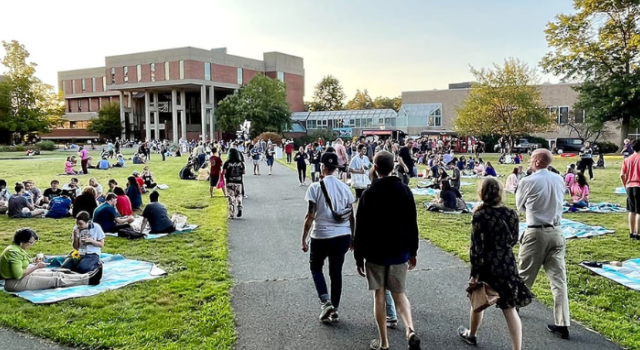
Photo: hampshire.edu
In early 2019, Hampshire College’s then-president Miriam Nelson decided that Hampshire could not afford to admit a regular class for its fall 2019 term. After alumni, faculty, students, and friends strongly objected, she resigned after just nine months, and in April 2019, I was honored to become Hampshire’s interim president.
Less than two months later I was invited by the New England Commission on Higher Education (NECHE) to discuss Hampshire’s accreditation. After meeting with our staff and me, NECHE asked Hampshire to return again six months later with its new, permanent president, Ed Wingenbach. It then decided not to place Hampshire on probation and asked the college to report back periodically.
Though Hampshire’s situation is markedly better now than it was seven years ago, again the commission has expressed a concern and is asking for a report in two months. Though I no longer have a formal role at Hampshire, I thought I should share how I view Hampshire’s progress today. In my opinion, it’s making good progress.
President Nelson’s 2019 decision meant that Hampshire’s student population dropped to 450. Since then, through the COVID years and during a political climate that disfavors small private colleges, Hampshire has regrown to about 750 students. That’s the size of many good colleges, but it’s not yet the size Hampshire wants to be. Hampshire’s strong leadership under its current president Jenn Chrisler, its enthusiastic alumni body, and its unique history are all helping it to regrow and flourish.
It might help to recall a bit of its history and to recognize Hampshire’s presence within the Five Colleges community. Hampshire is the creation of Amherst, Mount Holyoke and Smith Colleges and the University of Massachusetts Amherst which, during a 1958 summer faculty research program sponsored by the Ford Foundation, concluded that a new college — an “experimenting” college — should try out new ideas in higher education that might benefit them all without the risk that some new ideas might impose upon them. Just recently, the presidents and chancellor of those four parent institutions reiterated their very strong endorsement of their child, Hampshire College.
Hampshire’s first students arrived in 1970, so it’s only 55 years old. Financially, 55 is very young for a college. To take just one example, when Amherst College was Hampshire’s age it had serious financial problems but, over so many years since then, Amherst has become very well endowed financially.
Time really makes a difference. The other four colleges have one great financial advantage that Hampshire will only acquire with age. Its oldest alums are only in their early 70’s and while I know many of them have named Hampshire in their wills, very few of them have died. Over time, Hampshire will begin to benefit from bequests the way that the older colleges already do. (I’m a Hampshire parent as well as a former employee and Hampshire is in my will; I hope it will be a while before Hampshire has my money.)
As a product of the other four, Hampshire has advantages that few small colleges can ever have. It is located centrally to its parents, with a free bus service connecting them all. There are five-college faculty appointments, and students at any of the five can take courses at any of the other four at no charge to the student or the college. One Hampshire student I know is a music major at Hampshire, plays in the Amherst College symphony orchestra, and has taken math courses at two of the other colleges.
Its campus has become an educational village. The Yiddish Book Center, The Eric Carle Museum of Picture Book Art, and the Hitchcock Center for the Environment all are located at Hampshire College — each an independent non-profit that finds its presence at Hampshire to be mutually beneficial.
Hampshire’s creative innovations have had an influence in higher education, as its ideas have rolled out over the years and been adopted elsewhere. Of course, not all of its innovations have worked, as some experiments always do fail. But many have succeeded and do matter.
For one, the year assigned to a college student who enrolled at Smith last September was “2029” — for example, “Mary Doe ’29”. Just about every first year student at every college was so labeled last September, based on the assumption that the student will graduate in 2029. But at Hampshire that student would have been labeled “Mary Doe ’25”, identifying her with her entering cohort group. That’s because Hampshire has believed, from its very beginning in 1970, that an undergraduate education does not have to be four years long. A student might want to take extra years to work toward graduation in five or six years, or to work faster and harder and graduate in just three years (saving a lot of money as well as time). Interesting, isn’t it, that just this year other “four year” colleges are saying the very same thing, that three college years might be enough.
At even the most selective colleges, half of their students will find themselves in the bottom half of their class when they graduate. Not so at Hampshire, where there are no class rankings and no grades. That’s because Hampshire’s students help to design a curriculum that’s just right for them, work closely with faculty, and receive written evaluations in place of grades. Years ago, Hampshire worked with graduate schools to help them understand and then accept those evaluations as part of an applicant’s record rather than grades and class rank. The result: even the most exclusive graduate programs, law, medical and business schools have accepted Hampshire graduates.
Another way of looking at it is, Hampshire’s student-faculty relations and evaluations are more like the post-graduate world that its alums will enter than at any other undergraduate college. In business, you don’t get grades; you work with your supervisor for evaluations and advice that help you improve where necessary, and build on your successes. That’s probably the way it is for staff at NECHE, and at the media that may be reporting this story. So it is for undergraduates working with their professors at Hampshire College.
When Hampshire was just a planning document in the 1960’s, NECHE created a new category just for Hampshire — Candidate for Accreditation — so that it could qualify for federal grants and loans. Those funds then paid for Hampshire’s planning conferences, and are found in all the original Hampshire residences and academic buildings. Accreditation itself is important, but so are NECHE’s other references to a college it oversees, as the recent publicity of NECHE’s current review of Hampshire demonstrates. In a real sense, NECHE makes a material difference in the success of its colleges, and I trust that NECHE’s review will lead to its critical support, the kind of support that only the accrediting commission can provide.
Ken Rosenthal has been involved with Hampshire since 1966, was its first chief financial officer, taught law classes there, was a trustee, an interim president, and is the proud father of an alum.
Hear! Hear!
I arrived in Amherst in 1970, the same year as Hampshire College’s first entering class. Two years prior to that I had been a Whitehead Fellow at Harvard, which allowed me to pursue my interest in general systems theory as a model for educational institutions, and I recognized in Hampshire’s origins a commitment to systemic thinking that I was fumbling towards. Franklin Patterson’s “The Making of a College” (1966) was an exciting contribution to a notion of model-building as both a rigorous and humane approach to the messiness of life.
Ken Rosenthal’s comments hint at this – and his own contribution to the Hampshire story is profound and important – but I think that Hampshire’s survival in this time of upheaval in higher education is more essential than ever before. It is a college, not a university, and has no expectations of vast sums flowing in to support research (and the infrastructure behind it). Early on Hampshire endeavored to survive without an endowment, which meant that financial pressures would always be great and its dependence on the ongoing support of donors always paramount. Moreover, Hampshire’s model – like most models – was overdetermined and left both faculty and students exhausted, and allowed the messiness of life to seep in, despite its best efforts. Systems desire equilibrium at a time when circumstances require change.
Right now, Hampshire has to be seen publicly as a desirable college to attend for young people interested in change and in addressing the world’s catastrophic moment in time. Amherst, Mt. Holyoke, Smith and UMass should actively explain how their institutions have been affected by the existence of Hampshire. Accrediting organizations like NECHE should publicly address how they plan to support institutions and school systems that are creating alternative approaches to higher education.
For Hampshire, enrollment seems to be the key, and perhaps a more explicit commitment to Diversity, Equity and Inclusion should be part of that. Without income from an endowment that is indeed challenging but institutions, individuals, and models need to rise to the occasion.
Many outstanding colleges in the 1960s and 70s enrolled only a few hundred students, and many of those colleges more-than-doubled in size over those decades.
Embrace quality for quality’s sake and eschew quantity for quantity’s sake?!
Small is… and can be… beautiful!