
Town Council’s Vision for the Hampshire Campus: A Diverse Community and Not a Sterile Subdivision
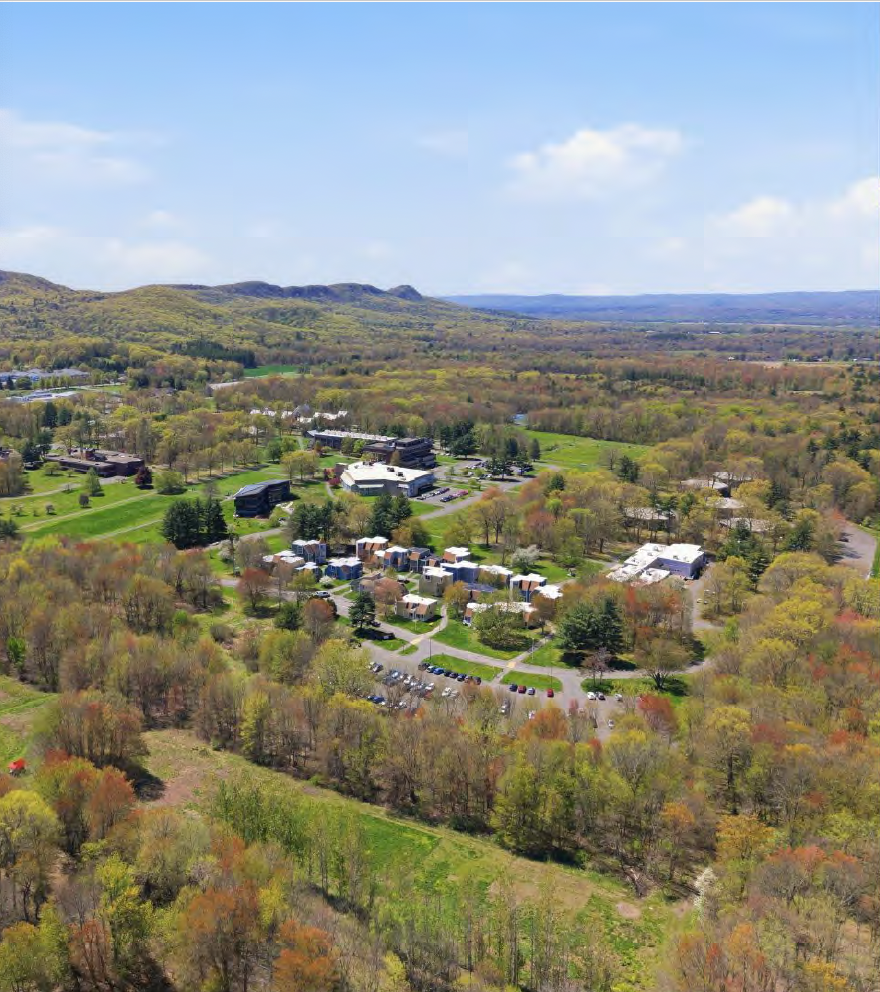
Aerial view of Hampshire College core campus. Photo: hampshire.edu
Report on the Working Session of the Amherst Town Council on the Rezoning of Hampshire College, August 31, 2026
This was a hybrid-format meeting, held in the Town Room of Town Hall and over Zoom. It was recorded.
Present
Town Councilors: Jill Brevik and Cathy Schoen (District 1), Amber Cano-Martin and Lynn Griesemer (District 2), Hala Lord and George Ryan (District 3), Pam Rooney and Jennifer Taub (District 4), Ana Devlin-Gauthier and Sam MacLeod (District 5). Andy Churchill, Mandi Jo Hanneke, and Ellisha Walker (at large)
Staff: Paul Bockelman (Town Manager), David Ziomek (Assistant Town Manager and Conservation Director), Jeff Bagg (Director of Planning and Economic Development)
Presenters: Consultants Nate Kelly (Principal, Horsley Witten Group) and Peter Flinker (Principal, Dodson Flinker Architects)
Councilors indicated they shared a vision for how they would like to see the Hampshire College campus developed.
There was broad agreement among the councilors to prioritize construction of housing, generate new revenue for the town, conserve the campus’ wetlands and farmlands, and effectively use the campus’ existing infrastructure – especially the multi-sports facility, tennis courts, and daycare center.
The purpose of this meeting was for town councilors to receive an updated report from the consultants on the ongoing study of possibilities for rezoning the Hampshire College campus and to give them a chance to brainstorm ideas for the project. While the consultants had previously discussed their work in a community-wide meeting and a planning board meeting, this was the first opportunity for town councilors to engage with them directly.
The session consisted of a PowerPoint presentation by the consultants, followed by a round robin in which councilors were asked for very brief responses to three framing questions:
- What are your top three goals or priorities for the future of the Hampshire campus?
- What are your greatest concerns or questions about the campus’ future?
- Looking ahead 20 years, what outcomes would lead you to consider the reuse of Hampshire College a success and what outcomes would you regard as signs that the town made the wrong decisions?
This was followed by a brief question-and-answer session among the consultants and the councilors.
Project Aims
The town initiated the study amid the Hampshire College Board of Trustees’ efforts to sell the 800-acre campus, following the April announcement that the college would close permanently at the end of the calendar year.
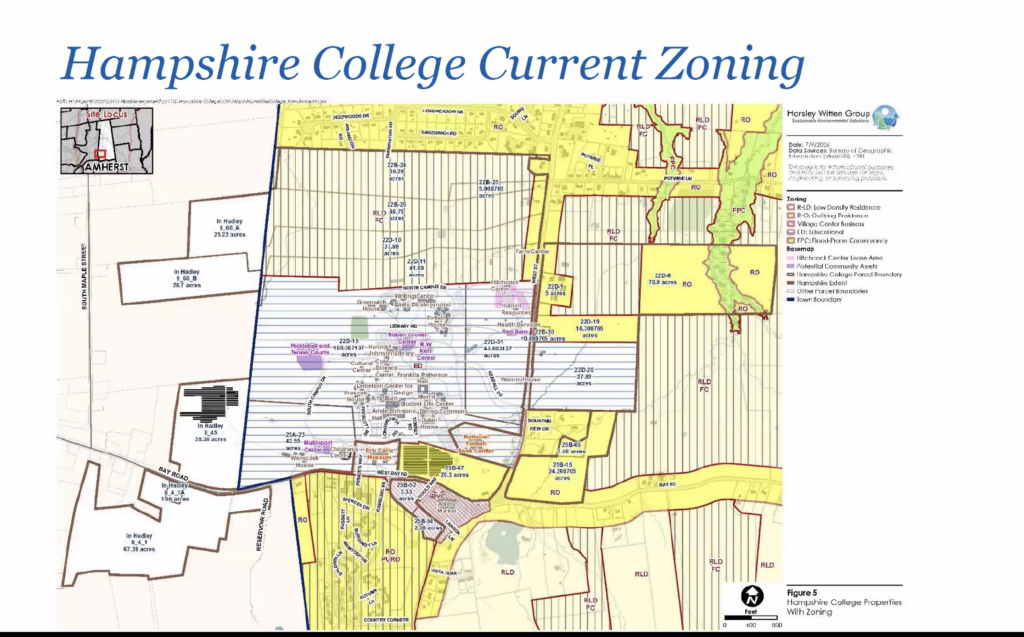
The study aims to clarify which parts of the campus are developable, the capacity of existing infrastructure (water, sewer, roadways), housing market demand, economic development opportunities, and possibilities for future reuse of existing buildings. The campus is currently zoned almost entirely as ED (education), and any use other than education will require rezoning. Town Manager Paul Bockelman has emphasized that while the town’s preference would be to see housing developed where possible, the study is not an attempt to determine for the Hampshire College trustees how the land should be used, nor is it an attempt to limit the options available for such use.
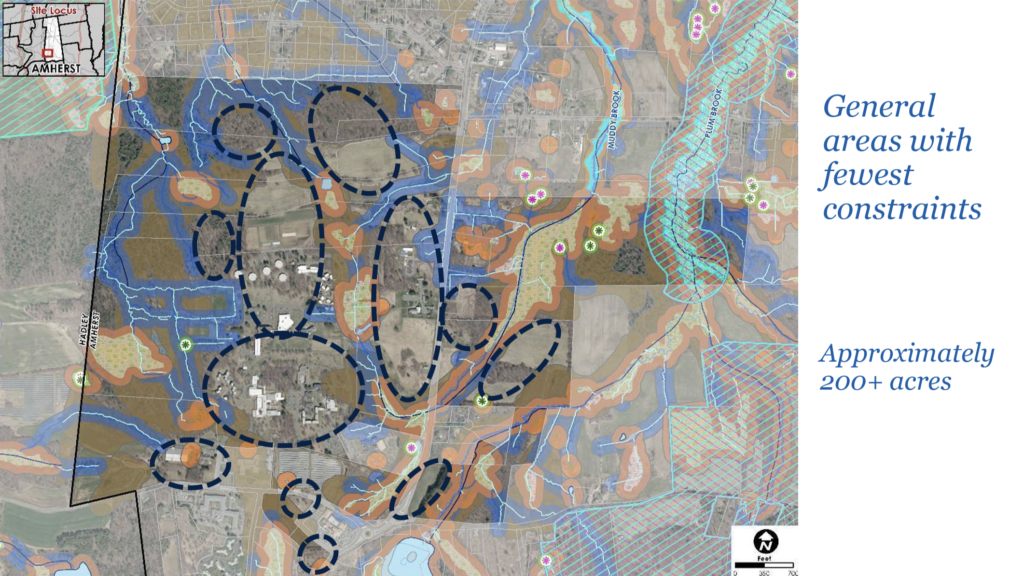
The town has obtained a grant from MassDevelopment to help with the study, which is being conducted in collaboration with MassDevelopment, the Horsley Witten Group (advisers on sustainable environmental solutions), U3 Advisors (advisers on real estate development), and Dodson & Flinker Landscape Architects (advisers on landscape architecture and planning). Based on preliminary studies of the property, consultants estimate that about 200 acres of the campus, centered on the current campus core, are suitable for development.
A Shared Vision
There was broad agreement among the councilors to prioritize construction of housing, generate new revenue for the town, conserve the campus’ wetlands and farmlands, and effectively use the campus’ existing infrastructure – especially the multi-sports facility, tennis courts, and daycare center. As for housing, most councilors wanted a diversity of housing types, with an emphasis on affordable and workforce housing. Many agreed with George Ryan, who said that 20 years up the road he would hate to see that the campus had become a sterile subdivision. Most spoke of an opportunity to create a vibrant and diverse community with village center amenities and not what Mandi Jo Haneke described critically as a housing silo.
Several agreed specifically with Hala Lord’s vision, the most holistic of the evening, which sought housing justice in a mixed income, multi-generational community that emphasized health and wellness, where the existing farmland would be conserved and protected for future generations, and where the campus was used to create jobs and the existing facilities would be put to use for the benefit of the greater community and would include the long-sought BIPOC youth center.
Lord later spoke of her desire to see the vision of Hampshire College continued on the property and how disappointing it would be if 20 years from now, the development was economically successful while Amherst had become less diverse and less affordable. She said she’d like the town to be able to say “we didn’t simply develop the land, but we created a community that contributed to the public good.”
Councilors mostly agreed with each other’s suggestions. One exception was when Mandi Jo Hanneke and Lynn Griesemer suggested that the town already places too much emphasis on conservation and that creating housing density should be prioritized over removing land from consideration for development because of conservation concerns. Hanneke said, “Conservation will produce less density and hence increase the cost of housing.”
While Hanneke called for a continuum of housing of all types, she voiced skepticism that workforce housing, which most of her colleagues emphasized, is needed and said she’d like to see evidence of market demand for it.
That skepticism was countered by Castle O’Neal of Mt. Holyoke Drive, who suggested during public comment that the councilors speak with people who work in the Amherst schools where they would find many town employees who want to live in Amherst but cannot afford to.
Greisemer and Ana Devlin Gauthier were the only councilors to explicitly mention data centers, both emphatically opposing their development on this land.
Some Unique Suggestions
Cathy Schoen called for preserving and continuing to use the nature trails that already cross the Hampshire campus.
Lynn Greisemer said she could imagine a continuum of housing connected to the Applewood retirement community, creating a continuum of care from homes, ready for seniors, to assisted living.
Jill Brevik pointed to the successful partnership with Valley CDC that created Amherst Community Homes in North Amherst and hoped the Hampshire campus development would involve similar partnerships for both housing and small business development.
Questions, Concerns, and Worries
Brevik and Schoen wanted to know how the consultants will estimate potential revenue generation from the project and how that might vary across different housing types.
Griesemer and Jennifer Taub wanted to know about the possible impacts of changing regional demographics. Griesemer noted that national trends affect how many folks come to town, citing declining graduate and international student enrollments at UMass as one example. She asked: If the population is generally declining in Western Mass, how do we build that into our planning?
Amber Cano-Martin and Lord worried about the prospects of having a meaningful participatory process on such a tight timeline (with the project slated for completion by the end of the year) and how much input the community will actually have into what will be done. Cano-Martin asked for purposeful efforts to ensure participation of non-English speakers.
Ellisha Walker, Devlin Gauthier, Schoen, and Ryan all raised the prospect of a single, tax-exempt buyer purchasing the entire property, as happened at Mt Hermon School in Northfield and Green Mountain College, in Poultney, VT. “Do we have a plan B if something like that happens?” Ryan asked.
Schoen wondered if the town might be able to better get what it seeks by zoning the land in pieces rather than developing a master plan for the entire property.
Some Consultant Responses
The consultants emphasized the need for a master plan for the entire area and the potential to use zoning creatively, in ways that look different from anything that the town currently does.
Nate Kelly noted that a lot of developments across the country right now are “throwing out the book on minimal lot size and frontage requirements and exploring small houses on small lots.” He said that here in Amherst, we have an option to think outside the box and to create a quicker path to homeownership.
Kelly also addressed the trepidation over who will buy the land. He said, “The rezoning will send a signal, and that is important to future developers. There is nothing that the town can do to prevent purchase by a religious or educational institution. But new zoning can send a signal to serious developers who are interested in building a community.”
Jeff Bagg reminded councilors that there will necessarily be tradeoffs and the need to balance competing goals.
What’s Next?
Two public listening sessions will be held at the Eric Carle Museum on Tuesday, Sept. 22 and Thursday, Sept. 24 at 5:30 p.m. Capacity for each session is limited to 150 people, so residents are encouraged to RSVP here.
The single family home of the future can be 900 square feet, as in Orchard Valley – net zero with a one car garage. (Yes, our homes are the same size as new ADUs.) The more space, the more we consume. Bike trails throughout and good public transportation to town and the colleges. A geothermal network for heating and a solar/battery microgrid for resilience.
I don’t believe “sterile” was the correct word being searched for, there are many communities in Amherst in which the homes are not sterile: Orchard Valley, the areas along East Pleasant street, north of the north fire station, the Echo Hill development. These homes are precious shelter. All land that can be developed needs to be used to combat the artificial scarcity driving up housing costs, something that Amherst is known for.