
Opinion: Amherst’s Five-story Zoning Gamble
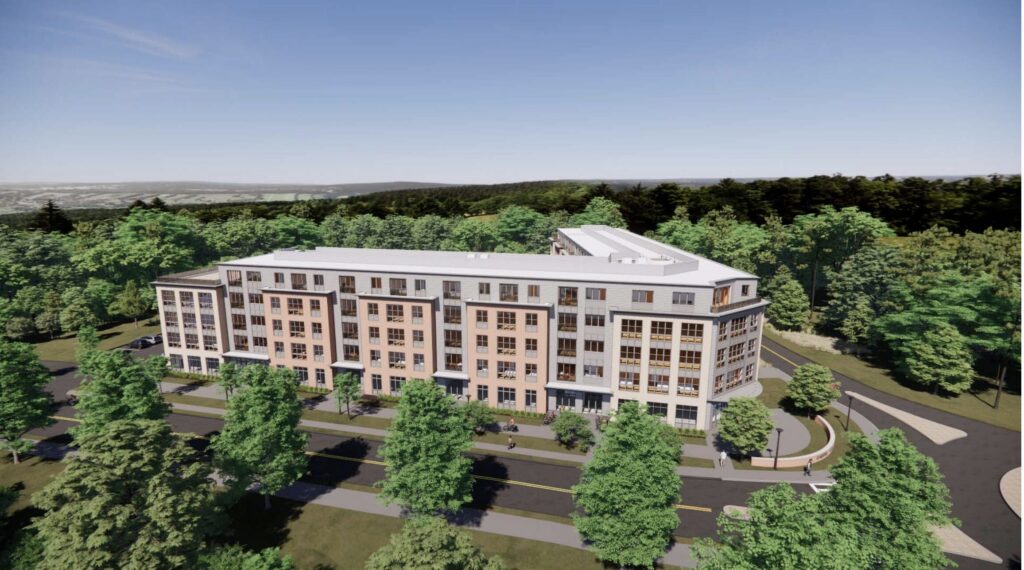
Architect's rendering of five-story apartment building currently under construction at Amity Street and University Drive. Photo: Kuhn Riddle Architects
Is Amherst planning for the community it wants to become, or simply reacting to today’s development pressures?

Amherst is considering a major change to its zoning rules that could reshape neighborhoods near the University of Massachusetts Amherst. The proposed Campus-Adjacent Overlay District would allow buildings up to five stories in designated areas. Before the town moves forward, residents deserve a closer look at the assumptions behind the proposal about university enrollment, student housing demand, public school enrollment, neighborhood character, and the long-term consequences of changing development rules.
A Zoning Line That Reaches into Established Neighborhoods
At its Sept. 30 meeting, the Amherst Planning Board, chaired by Doug Marshall, presented a draft of the Campus-Adjacent Overlay District. The proposal identifies two main areas. The first lies north of Fearing Street and extends from Sunset Avenue toward North Pleasant Street. It includes properties fronting Sunset Avenue, McClure Street, Lincoln Avenue, Nutting Avenue, Allen Street, and Phillips Street. The second lies along East Pleasant Street, east of UMass.
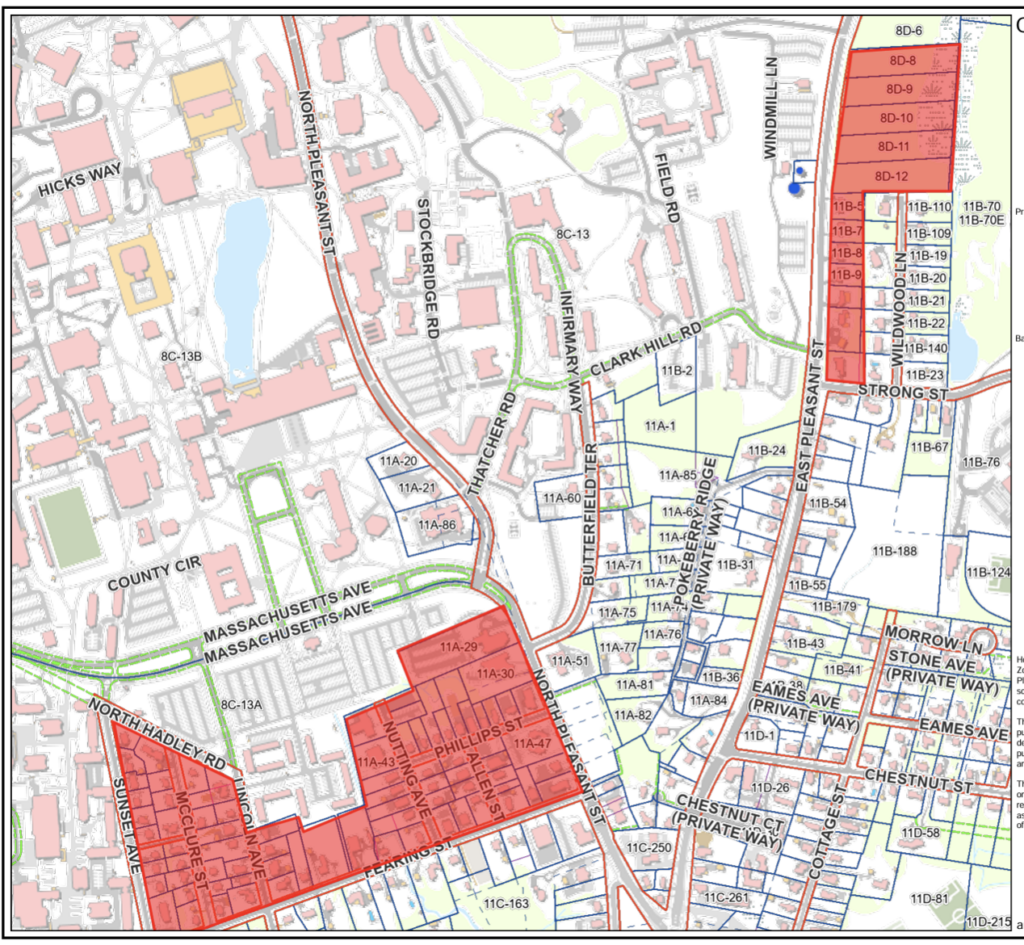
The draft would allow buildings of up to five stories, with a three-story limit next to residential areas. It also sets a minimum frontage of 40 feet, 20-foot setbacks, and a minimum lot size of 12,000 square feet.
During the discussion, Planning Board member Angus McLeod acknowledged that the proposal could bring dramatic changes to established neighborhoods. The board also discussed UMass’ position that it has no plans to expand on-campus housing. Board member Jesse Mager asked whether Phillips and McClure streets could accommodate larger apartment buildings. The possibility of discontinuing some streets was also raised.
These are not minor adjustments to a zoning map. They raise questions about the scale of development, the capacity of existing streets and infrastructure, and the future of neighborhoods that have long been part of Amherst’s residential fabric.
See Related
Should Large Housing Projects Be Allowed in Neighborhoods Near UMass? (Amherst Indy)
Opinion: Who Benefits from Amherst’s Campus-adjacent Zoning? (Amherst Indy)
The Enrollment Question Nobody Should Skip
Before Amherst rewrites its zoning rules around a presumed need for more student apartments, it should take a hard look at the numbers. Assuming university enrollment will keep growing indefinitely is not a planning strategy. It is a projection, and projections have a habit of becoming inconvenient when reality refuses to cooperate.
Enrollment in Amherst’s public schools has declined substantially over the past few decades. According to the town’s June 2025 Housing Production Plan, enrollment in the Amherst-Pelham regional schools fell from 3,805 students in 1998-99 to 2,220 in 2024-25, a decline of about 42%.
| School year | Enrollment |
|---|---|
| 1998-99 | 3,805 |
| 2004-05 | 3,540 |
| 2009-10 | 3,107 |
| 2014-15 | 2,761 |
| 2019-20 | 2,564 |
| 2020-21 | 2,419 |
| 2021-22 | 2,440 |
| 2022-23 | 2,411 |
| 2023-24 | 2,322 |
| 2024-25 | 2,220 |
Source: Town of Amherst Housing Production Plan, June 2025. Elementary enrollment includes Pelham; middle and high school enrollment includes the other communities in the regional district.
The decline matters to any broader discussion of Amherst’s future. By itself, it does not determine how many university students will need housing or how much new development the town should allow. But it does challenge the idea that growth should be treated as inevitable across the community.
A New School, Built for a Different Future
Amherst’s investment in Amethyst Brook Elementary School offers another view of the town’s changing demographics. The school opened this fall, replacing Fort River and Wildwood Elementary Schools. The roughly $99 million project is a three-story, 105,750-square-foot building designed for 565 students in kindergarten through fifth grade. Its net-zero energy features include ground-source heat pumps and solar panels. Voters approved the debt exclusion to fund it in May 2023.
The project is a substantial investment in the town’s public schools, and its design and capacity make the enrollment question all the more important. Amherst must plan responsibly for the students it has, the students it may attract, and the long-term costs of maintaining public buildings.
UMass Enrollment Is No Longer Climbing
UMass Amherst enrollment grew considerably over the past two decades, but the recent figures tell a different story. Total enrollment peaked at 32,229 in fall 2022 and has declined every year since, reaching 29,580 in fall 2026, about 8.3% below the peak.
| Fall | Undergraduate | Graduate | Total |
|---|---|---|---|
| 2000 | 18,521 | 5,532 | 24,053 |
| 2005 | 19,511 | 5,582 | 25,093 |
| 2010 | 21,373 | 6,133 | 27,506 |
| 2015 | 22,748 | 6,521 | 29,269 |
| 2020 | 24,233 | 7,409 | 31,642 |
| 2021 | — | — | 32,045 |
| 2022 | — | — | 32,229 |
| 2023 | — | — | 31,810 |
| 2024 | 23,920 | 7,806 | 31,726 |
| 2025 | 23,116 | 7,299 | 30,415 |
| 2026 | 22,800 | 6,780 | 29,580 |
Source: UMass Amherst University Analytics and Institutional Research. Undergraduate and graduate figures are shown where available.
The recent decline does not mean demand for student housing will disappear. Enrollment totals do not tell the whole story. The number of students living on campus, the number seeking off-campus housing, graduate enrollment, household size, and the university’s future housing policies all matter. But a zoning proposal meant to shape Amherst for decades should not rest on a single assumption of continuous university growth.
Off-campus Housing: What Do the Numbers Show?
The Housing Production Plan also tracks where students live in Amherst and nearby communities. It shows the number of students living in Amherst rising from 8,290 in 2022-23 to 9,136 in 2024-25, while the number living in nearby communities fell from 1,832 to 1,629.
| Academic year | Students in Amherst | Students in nearby communities |
|---|---|---|
| 2022-23 | 8,290 | 1,832 |
| 2023-24 | 8,938 | 1,806 |
| 2024-25 | 9,136 | 1,629 |
Source: Town of Amherst Housing Production Plan, June 2025.
These figures reinforce the same point: Before making sweeping changes to neighborhood zoning, Amherst should understand where students live now and how the university’s future housing decisions may affect demand.
Growth Needs a Public-interest Test
Purpose-built student housing could help slow the conversion of single-family homes into shared student rentals. It could also add housing near campus and ease pressure on other residential areas. Those are legitimate goals, and Amherst should not dismiss them.
But allowing five-story buildings in established residential neighborhoods is a consequential decision. The town should examine how new development would affect traffic, parking, sidewalks, water and sewer capacity, stormwater management, trees, public services, and the scale of surrounding homes.
A zoning change that increases private development opportunities should also deliver measurable public value.
It should also ask whether the new housing will be genuinely affordable, who will benefit from it, and what public benefits should be required in exchange for expanded development rights. A zoning change that increases private development opportunities should also deliver measurable public value.
Amherst needs to consider several scenarios rather than assume a single future. What happens if UMass enrollment keeps declining? What if it stabilizes? What if it grows again? How much more student housing will the university provide? And what kind of housing does Amherst need for families, workers, older residents, and people who want to remain in the community?
A thoughtful zoning policy can accommodate change without treating every neighborhood as a blank slate. The town should weigh the benefits of more housing against the costs to infrastructure, the character of existing streets, and the needs of the wider community.
Rizwana Khan is a writer, educator, and human rights advocate in Amherst.