
School Supporters Voice Concerns About FY27 Budget

Photo: istock
Report on the Meeting of the Amherst Finance Committee, May 11, 2026
This meeting was a hybrid meeting held at Town Hall. It was recorded.
Present Cathy Schoen (District 1, chair), Jill Brevik (District 1), Lynn Griesemer (District 2), Ana Devlin Gauthier, and Sam MacLeod (District 5). Resident Nonvoting members: Cathleen Mitchell, Tom Porter, and Joseph Jayne.
Staff: Sean Mangano (finance director), Paul Bockelman (town manager), and Athena O’Keeffe (clerk of council).
After a brief budget presentation by Finance Director Sean Mangano, several members of the public advocated for more funding for Amherst’s elementary school. The Amherst School Committee (ASC) voted for a budget 5.87% greater than the FY26 budget, but the town manager’s budget allocated an increase of 5.1% — about $500,000 less than the ASC requested.
That shortfall will require reductions in teachers of “specials” (art, music, library, physical education, and technology), special education, and intensivists in reading and math. Other town departments received increases of 3.85% for the library, 3.5% for the regional schools, and 4.85% for town departments. The town department increase includes an extra $200,000 to fill one firefighter/EMS position that had been frozen and to add an additional position, funded through the ambulance fund.
Parent Sarah Johnson said, “Cuts to intensivists and special education teachers will have bigger impacts on the school community and Amherst as a whole. I’ve heard special education teachers giving public comment on how they won’t be able to meet the needs of students on IEPs (individualized education programs). These cuts do not eliminate costs. They simply shift them. If families feel their children’s needs are not being met, they will choose to leave the district, taking funding with them. Without enough early literacy support, more students will get referred to special education later, which is significantly more expensive per student.” Johnson also pointed out that cuts to special education teachers will shift the unmet needs of students onto general education teachers, affecting all students.
Eli Mayer said his children had a good experience at Wildwood Elementary School “and I want to continue living in a town that has kids around and schools that are doing a great job for those kids.”
Art teacher Laura Evonne Steiner noted that the school committee “has been listening to the folks on the ground and the people that work with kids day in and day out. We know what’s needed to make a school function. Everyone’s really excited about Amethyst Brook as a building, but don’t you think that we should value the humans that are going to be in that space? The percentage that the town gives to schools is less [than in past years], but it really should be more, so that we can meet the needs of all our students.”
Allegra Clark stated, “I’m having a really hard time sitting with the presentation saying that we’re valuing education and equity when the schools are still going to be losing positions and CRESS will still be frozen at six responders. Despite the consolidation of the two schools, there’s actually the addition of Chestnut Street Academy [for sixth graders], which wipes out any gains we might have made in reducing costs.” Clark also noted “significant safety concerns” in her child’s third-grade class at Wildwood, saying it is hard to manage 70 third graders on the playground during recess with only two adults.
ASC member Bridget Hynes said, “Amethyst Brook is the culmination of a long planning process and tremendous collaboration. And it’s a financial commitment that puts our values as a town fully on display. [But] what’s on the inside is equally important. We’re on the threshold of making decisions that are going to impact what takes place inside the building. It’s a chance to show that we collectively are committed to the high-value education that we built this building to provide.”
Angelica Bernal and Ellen Jedry-Guidera represented the steering committee of the Special Education Parents’ Advisory Committee (SEPAC) to “express our deepest concern about the ways our budget shortfalls are impacting special education programs and will pose a critically untenable situation in the coming year. Insufficient funding has strained our teachers and paraprofessionals for far too long.” Bernal noted the high turnover of special education staff. Jedry-Guidera added, “This is not just about what we want; this is what we need.”
In other comments, Sarah Forsaith, president of the firefighters union, said the Amherst Fire Department remains severely understaffed but that she appreciated the increase in firefighter/EMS positions for the coming year and the plan to reach full staffing by adding five more positions over the next two years. She emphasized the greatly increased number of calls the department has handled in recent years.
Casey Maloney asked for a clearer, more accessible budget proposal that includes a summary. She said the executive summary is 20 pages long and contains no simple breakdown of where money goes. The total budget document is 300 pages, and it’s not realistic to expect residents to read it in full and participate meaningfully in the process.
Mangano Highlights Features of the Budget
Mangano presented a condensed version of the FY27 budget that was introduced at the May 4 Town Council meeting. The full $107.1 million budget is available on the town’s website. Mangano highlighted “investments in public works, public education, and public safety,” consistent with guidelines approved by the Town Council last fall.
The budget represents a 3.8% increase over FY26. The capital program is $10.3 million, or 10.5% of property tax revenue — the target amount needed to fund four major building projects (elementary school, Jones Library, DPW building, and new fire station) that have been prioritized since 2019.
Of the total budget, 47% goes to education, 12% to public safety, and 10% to general government. Because the regional schools allocation came in under the 3.85% increase set by the guidelines, the excess $70,000 was applied to the elementary schools under the regional agreement with the four towns. An additional $389,000 was added to the elementary schools from the prior year’s free cash allocation, intended as a one-time investment.
Roads and sidewalks — also a resident priority — will receive $5 million from the operating budget, supplemented by capital investment, to fund year one of a five-year plan to improve roads and sidewalks. The budget also includes the purchase of a second asphalt hot box, which will double the town’s capacity to patch potholes.
Part-time positions were added for the aquatics program and the morning movement mentoring program at a combined cost of about $45,000. The capital plan includes $200,000 for sustainability initiatives and another $200,000 for planning the future use of the Wildwood Elementary School building and the Hampshire College campus. It includes debt payments for the new elementary school (28% of capital expenses) and the Jones Library (11%), but no additional debt payments.
Capital improvements of $175,000 are planned to improve accessibility at Crocker Farm Elementary School, with additional funds anticipated for next year, and $750,000 is allocated for repairs to town buildings, for a total of $1.19 million in local capital expenses.
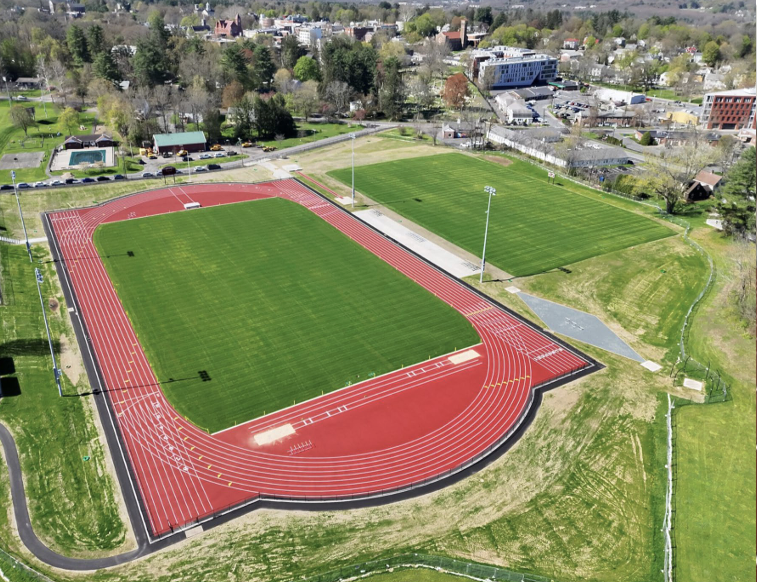
The coming year will see the opening of the new track and field at the high school, Amethyst Brook Elementary School, the expanded Jones Library, and a public restroom at Kendrick Park. A designer will also be hired to begin planning a new DPW facility.
The water and sewer enterprise funds are each receiving a new position and $400,000 to replace the roof at the Atkins water treatment facility, with those increases funded through higher water and sewer rates.
The Finance Committee will continue to meet on Zoom every Tuesday at 1 p.m. and Thursday at 3:30 p.m. throughout May. A public hearing on the capital plan is scheduled for June 1. The Town Council will vote on the budget June 15. Comments can be submitted to the Finance Committee through Mangano at manganos@amherstma.gov.