
Swimming Still Not Recommended at Puffer’s Pond
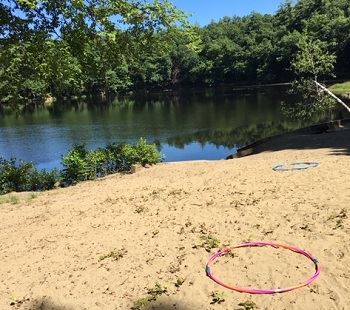
Beach at Puffers Pond. Photo: amherstma.gov
While town water testing at Puffer’s Pond on August 10 indicated that bacterial counts at both beaches are now within state safety limits for E.coli, the geometric mean for the last five tests at the south beach still exceeds the state’s safe limits for swimming, and hence swimming is not recommended at the pond. Signs have been posted at both beaches.
Sampling at the north beach produced a reading for E. coli of 9.7 MPN/100ml and the reading at the south beach yielded a reading of 42.6 MPN/100 ml. The state allowable limit for safe swimming is 235 MPN/100 ml. The geometric mean at the north beach was 22.69 MPN/100 ml. The geometric mean at the south beach was 222.39. The state threshold for safe swimming for geometric mean is 126 MPN/100 ml.
In Massachusetts, public bathing water quality standards require tracking the geometric mean alongside single samples. The geometric mean uses the most recent five sample results within the same calendar year to reflect typical baseline water quality over time rather than a single isolated spike.
Puffer’s Pond has been under a no swimming recommendation for four of the last five weeks due to high E. Coli counts.
Several recent samples have been high enough that they will continue to affect the overall average (geometric mean) for weeks to come, even if a single future water quality test shows lower E. coli levels. This means that while water quality may improve, the pond may still not meet the state’s swimming standard. Based on recent test results, it is possible that swimming may not be recommended for the rest of the season.
The town conducts weekly water quality testing during the swimming season (Memorial Day – Labor Day). Results are typically posted by Wednesday afternoon on the Puffer’s Pond website.
The Amherst Public Health Department is responsible for making the decision about swimming closures and is the point of contact for questions. The Public Health Department can be contacted by emailing publichealth@amherstma.gov or calling 413-259-3077.
What is the source of this perennial bacteria problem?